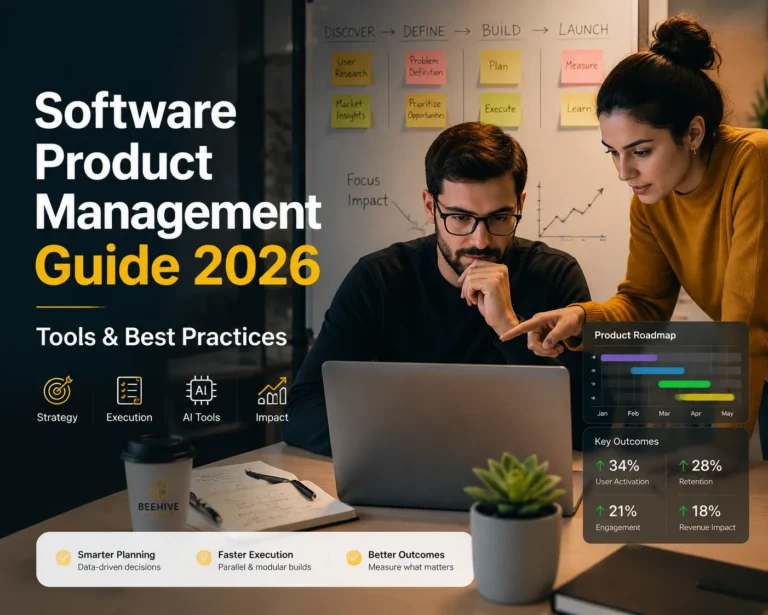
Software Product Management Guide 2025 – Tools & Best Practices

Bringing a great product to life isn’t just about writing specs and managing Jira tickets. It’s about making the right decisions early: aligning business goals with technical feasibility, scoping intelligently, and shipping something that actually works. The best product managers today aren’t guessing. They’re backed by data, iteration, and battle-tested frameworks.

That’s where Beehive Software steps in. We help you move from product vision to production system. Faster, leaner, and with 10x less waste. Our global experts and AI-accelerated build system help PMs avoid endless scope creep, vendor lock-in, and dev cycles that lead nowhere.


TL;DR

In 2025, product managers face sharper pressure than ever: faster GTM timelines, tighter budgets, and growing complexity across tools, teams, and tech stacks. The smartest product leaders are cutting through that noise with lean processes, AI-enhanced research, and execution partners like Beehive. We don’t just help you manage the roadmap, we help you architect, build, and deliver working software that scales. From research to launch, Beehive compresses timelines, tightens delivery, and removes the chaos.


Key Points

  • Product management today is less about managing sprints and more about connecting user insight to execution—fast.
  • Most teams burn months on poor discovery, ambiguous prioritization, or weak alignment between PMs and devs.
  • Agile, Kanban, and Lean all work—but only when paired with clearly scoped goals and expert cross-functional support.
  • Beehive helps product leaders avoid false starts by offering discovery-to-delivery services, not just dev shops.
  • From workshops and wireframes to tested code and scalable infrastructure, Beehive doesn’t just advise—they ship.
  • Beehive’s modular, AI-powered tasking system keeps builds lean, teams focused, and timelines short without compromising quality.
Software Product Management Methodologies and Frameworks

Software Product Management Methodologies and Frameworks

Agile Done Right (With AI-Human Precision)

Agile isn’t magic. It works only when tightly scoped and rigorously executed—something most teams get wrong. At Beehive, we treat Agile as a system, not a slogan. Our modular tasking engine decomposes product work into small, trackable units, then routes them through expert hands and AI-enhanced workflows to ensure speed, quality, and alignment.

While 82% of companies use project management tools, only a fraction implement Agile with discipline. Beehive fixes that gap by combining outcome-focused practices with execution accountability. We don’t chase velocity, we measure validated learning and delivered value.

Key Quote Alignment:

“The most successful product people focus on outcomes over outputs.” — Jeff Patton

Beehive builds systems that let PMs measure outcomes clearly, cut scope bloat, and ship useful product faster.

Structured Sprints Without the Bureaucracy

Scrum and Kanban aren’t one-size-fits-all. Most teams either over-ritualize (too many standups, not enough momentum) or under-commit (too little planning, endless chaos). Beehive integrates both when appropriate—leveraging Scrum’s cadence for complex builds and Kanban’s flexibility for continuous shipping.

What makes it work: our sprint planning isn’t guesswork. Every backlog item is scoped, priced, and assigned with AI-human confidence. And our microtasking system keeps WIP low, blockers visible, and throughput high—even across distributed teams.

Lean Product Development, Backed by Real Feedback

MVPs fail when teams build assumptions instead of insights. Beehive’s approach is lean, but not lazy. We build “minimum testable products”—functioning units that validate multiple factors at a time. This is how you go to market faster, without sacrificing stability or learning.

We help PMs run real experiments:

  • What will users pay for?
  • What friction is worth solving?
  • What does usage tell us about product fit?

AI helps us synthesize that data fast, and our engineering team adapts based on actual user behavior—not opinions.

Build-Measure-Learn, Without Guessing

Shipping is easy. Scaling is not. At Beehive, every build starts with technical due diligence to ensure complex systems don’t break when growth hits.

We wire in telemetry, usage metrics, and experiment tracking from day one—not after the fact. That means every feature does more than function. It feeds a learning loop.

Our architecture is designed for tight, testable feedback cycles that reveal what’s working, what’s not, and what to build next.

We don’t ship for release day. We build for outcomes—measured in traction, not tickets closed.

MVPs With Just Enough Muscle

An MVP isn’t a sloppy beta—it’s a focused solution to a real problem. At Beehive, we scope Minimum Viable Products that deliver insight and impact from day one.

We start by aligning every feature to a clear job-to-be-done, ensuring your MVP does two things:

  1. Solves a core user problem
  2. Generates feedback that drives the next iteration

If it doesn’t teach us something useful or move the needle it doesn’t ship. We don’t just build to launch. We build to learn, adjust, and grow.

Design Thinking Meets Developer Thinking

Beehive blends user-first thinking with builder discipline. Our design phases aren’t pixel polish—they’re empathy engines. Through workshops, interviews, and sketch-to-sprint sessions, we help product teams align what users want with what’s feasible to build.

And because we integrate design directly into our tasking system, every idea has a clear build path.

OKRs That Connect Strategy to Shipping

Setting goals is easy. Building them into product decisions is where most teams fail. Beehive connects OKRs to build plans with traceable task flows—so every sprint contributes to a business outcome, not just a Jira status.

We work with PMs to define:

  • Strategic Objectives
  • Key Results mapped to product usage
  • Execution plans that deliver on both

And because we ship fast, we review progress often, realigning with your team every sprint or milestone.

Wrap-Up Summary for Section

Beehive doesn’t teach you frameworks. We turn them into functioning systems. Whether you use Agile, Scrum, Kanban, or Lean, we bring the precision and execution infrastructure to make it work—across AI-human workflows, modular tasking, and outcome-driven delivery.

Software Product Management Guide

Software Product Lifecycle Management

Software product lifecycle management encompasses the systematic approach to guiding products from initial conception through development, launch, optimization, and eventual retirement. This comprehensive framework ensures products evolve strategically while maintaining alignment with market needs and business objectives throughout their entire lifespan.

The lifecycle approach recognizes that product management requirements change significantly as products mature. Early-stage products require extensive discovery and validation, while mature products need optimization and competitive differentiation strategies. 72% of large manufacturing companies use PLM software to manage these complex transitions effectively.

Recent trends emphasize data-driven lifecycle management and AI-powered analytics that provide real-time insights and automated optimization recommendations. This technological evolution enables more sophisticated lifecycle management while reducing manual effort required to maintain product health and market relevance.

Product Discovery Phase

Product discovery represents the investigative foundation of successful software products, requiring teams to identify genuine market opportunities, validate problem significance, and explore solution approaches that deliver meaningful user value while achieving business viability.

Discovery balances thorough investigation with speed-to-market pressures. Teams must gather sufficient evidence to make confident decisions while avoiding analysis paralysis that delays competitive advantage. Effective discovery processes establish clear validation criteria and timelines that guide investigation scope and decision points.

Problem Identification and Validation

Problem identification begins with systematic market research that uncovers unmet needs, user frustrations, and emerging opportunities. Product managers employ diverse research methodologies, from user interviews to market surveys, ensuring comprehensive understanding of target audience challenges and motivations.

Validation transforms problem hypotheses into evidence-based insights through rigorous testing and measurement. Teams design experiments that measure problem significance, user willingness to pay for solutions, and market size estimates that inform investment decisions and strategic prioritization.

The validation process must balance speed with thoroughness, ensuring teams gather sufficient evidence without delaying market entry unnecessarily. Clear validation frameworks help teams make objective go/no-go decisions based on predetermined criteria rather than subjective judgment.

Solution Exploration and Ideation

Solution exploration involves generating and evaluating multiple approaches to validated problems. Product managers facilitate brainstorming sessions, competitive analysis, and technical feasibility assessments that reveal promising solution directions while identifying potential obstacles and constraints.

Spotify’s transformation of the music industry demonstrates effective solution exploration. Facing declining physical sales and consumer migration to piracy, Spotify developed a user-friendly, dual-model platform with both ad-supported and premium options, prioritizing accessibility while addressing industry stakeholder concerns. This approach redefined the global music industry’s revenue model and established Spotify as the leading streaming service.

Rapid prototyping and concept testing enable teams to evaluate solution approaches quickly and cheaply before committing significant development resources. This experimental approach reduces the risk of building products that fail to achieve market acceptance or technical feasibility, though it requires disciplined hypothesis formation and objective result interpretation.

Product Development and Launch

The development and launch phase translates validated concepts into market-ready products through structured execution processes. This phase requires careful coordination between multiple teams while maintaining flexibility to adapt to emerging insights and changing market conditions.

Development approaches have evolved significantly with widespread adoption of agile methodologies and continuous deployment practices. Teams can now release features incrementally while gathering user feedback that informs ongoing development priorities and optimization opportunities.

Development Sprint Management

Sprint management provides structured frameworks for organizing development work while maintaining focus on user value delivery. Product managers facilitate sprint planning, backlog refinement, and regular retrospectives that keep teams aligned around shared objectives and responsive to changing requirements.

Beehive Software employs agile methodologies as the core of their development cycle, breaking projects into two-week sprints with deliverable-focused milestones. This approach allows for frequent feedback, rapid adaptation, and continuous improvement throughout the development process.

Effective sprint management balances predictability with flexibility, providing teams with clear goals while enabling adaptation based on technical discoveries and user feedback. Regular communication about progress and obstacles ensures stakeholders remain informed and can provide support when needed. However, maintaining sprint discipline while accommodating changing priorities remains a persistent challenge.

Go-to-Market Strategy Execution

Go-to-market execution coordinates product launches across marketing, sales, and customer success teams to maximize adoption and revenue impact. Product managers develop comprehensive launch plans that address messaging, positioning, pricing, and distribution strategies tailored to target market segments.

Launch coordination involves extensive preparation, from sales enablement materials to customer support documentation. Teams must anticipate potential user questions, technical issues, and competitive responses while preparing appropriate mitigation strategies.

Post-launch monitoring tracks initial market reception, user adoption patterns, and performance metrics that inform immediate optimizations and longer-term strategic adjustments. Rapid response capabilities enable teams to address issues quickly while capitalizing on unexpected opportunities, though balancing immediate fixes with longer-term strategic objectives can be challenging.

Post-Launch Optimization

Post-launch optimization represents the ongoing process of improving product performance, user satisfaction, and business outcomes through data-driven enhancements and strategic refinements. This phase often determines long-term product success more than initial feature sets or launch strategies.

Optimization requires systematic monitoring of user behavior, business metrics, and competitive dynamics to identify improvement opportunities and prioritize enhancement investments. Teams must balance new feature development with existing functionality improvements while maintaining product stability and user satisfaction.

Performance Monitoring and KPI Tracking

Performance monitoring involves continuous measurement of key indicators that reflect product health, user satisfaction, and business impact. Product managers establish comprehensive monitoring frameworks that track technical performance, user engagement, retention rates, and revenue metrics across different user segments and time periods.

A fully optimized product manager can increase company profits by 34.2%, demonstrating the significant business impact of systematic performance optimization. This improvement results from data-driven decision making, user-centered enhancements, and strategic feature prioritization based on evidence rather than assumptions.

Monitoring systems must provide real-time alerts for critical issues while enabling deeper analysis of trends and patterns that inform strategic decisions. Integration with analytics platforms and user feedback systems creates comprehensive views of product performance that guide optimization priorities, though data interpretation and action prioritization remain challenging skills.

Continuous Improvement and Iteration

Continuous improvement processes establish regular cycles of analysis, hypothesis formation, experimentation, and implementation that drive ongoing product enhancement. Teams develop systematic approaches to identifying optimization opportunities while maintaining development velocity and product stability.

Iteration cycles balance user feedback with business objectives, ensuring improvements deliver value to both users and organizations. Product managers prioritize enhancements based on impact potential, implementation complexity, and strategic alignment with broader product objectives.

The improvement process benefits from cross-functional collaboration, where engineering insights about technical optimization opportunities combine with user research findings and business analysis to identify high-impact enhancement possibilities. However, maintaining momentum while managing technical debt and competing priorities requires careful resource allocation and stakeholder management.

Product Sunset and End-of-Life Planning

Product sunset planning manages the strategic retirement of products or features that no longer align with business objectives or market demands. This process requires careful consideration of user impact, business continuity, and brand reputation while executing transitions that minimize disruption and maintain customer relationships.

Sunset decisions involve complex evaluations of maintenance costs, opportunity costs, competitive implications, and user migration possibilities. Product managers must balance business efficiency with customer satisfaction while communicating changes transparently and providing appropriate transition support.

End-of-life planning includes migration pathways for affected users, timeline communication, and support for alternative solutions. Thoughtful sunset execution preserves customer trust while enabling organizational focus on higher-impact product investments, though managing customer concerns and competitive implications remains challenging.

Beehive: Your Execution Edge

Product success isn’t just about planning faster. It’s about executing smarter—with fewer handoffs, clearer scope, and systems that ship.

At Beehive, we help you avoid the trap of beautiful roadmaps with broken delivery. We co-own your outcomes—breaking your vision into modular, scoped builds executed by experts, governed by quality gates, and delivered in weeks, not quarters.

Whether you’re validating a new product or scaling an existing one, we’re not a dev shop. We’re your execution system.

Let’s turn your roadmap into revenue.

Talk to Beehive →

Frequently Asked Questions

What’s the Difference Between Product Management and Project Management?

At Beehive, we view product management as owning the why and what—the strategic drivers behind what gets built. Product managers set the vision, define user problems, and shape the roadmap based on market fit and business impact.

Project management, on the other hand, owns the how and when. It’s about managing delivery mechanics: timelines, resource allocation, and keeping execution tight.

We don’t silo these roles. Beehive’s modular execution model lets PMs stay focused on outcomes, while our system automates coordination, progress tracking, and task accountability—reducing the overhead that slows down most teams.

In short: Traditional teams split strategy and execution. We build systems that connect them—so you can move fast without missing the big picture.

How Do Technical and Non-Technical Product Managers Work in Beehive’s Model?

Technical PMs bring deep system knowledge—they understand APIs, data models, architecture trade-offs. They thrive in high-complexity builds.

Non-technical PMs bring sharp user empathy, go-to-market instincts, and business alignment. They excel in customer-facing products and iterative experiments.

In the Beehive system, both types win. Our tasking engine deconstructs builds into clear execution units, so technical PMs can deep dive when needed, and non-technical PMs can confidently drive outcomes without writing a line of code.

What matters most: the ability to connect user value to execution. Beehive gives PMs the structure and tooling to do exactly that—regardless of background.

What Certifications Actually Matter in Product Management?

We don’t hire based on badges. But that doesn’t mean learning stops.

Certifications like:

  • Scrum Product Owner (CSPO)
  • Pragmatic Institute
  • PMI-ACP
  • Reforge

    …can help PMs build mental models.

But in fast-moving teams, execution trumps theory. Beehive favors PMs who’ve shipped, navigated ambiguity, and made hard tradeoffs under pressure. We provide systems that complement those instincts—lean, scoped, and outcome-driven.

Bottom line: certifications can open doors. Our system helps you walk through them and deliver.

How Can Engineers Transition Into Product Management?

Engineers already think in systems. That’s 80% of the job.

To shift into product management, engineers need to add:

  • Customer exposure
  • Strategy understanding
  • Stakeholder fluency

At Beehive, we support technical PMs through structured workflows—where every task has business context, every sprint links to OKRs, and every build decision connects to user needs. Engineers can grow into product roles without guessing what matters.

Pro tip: Start owning problem statements, not just feature specs. Beehive’s scoped tasking system makes it easier to bridge the gap between execution and ownership.

What Are the Most Common Pitfalls in Software Product Management?

We’ve seen the same failures over and over:

  • Building without validating (guessing instead of testing)
  • Endless prioritization churn (no tie to outcomes)
  • PM–dev misalignment (no shared scope definition)
  • Scope bloat and missed timelines (no constraints or feedback loops)

Beehive exists to eliminate these. Our product workflow embeds:

  • Validated learning (real users, real feedback)
  • Modular tasking (to avoid scope creep)
  • Built-in measurement (usage, velocity, impact)
  • Clear role boundaries (PMs lead strategy, our system ensures execution)

Product management breaks down when there’s no system. Beehive is that system—one that lets PMs focus on building the right thing and trust that it’ll actually get built.

Related Posts

Leave a Reply

We are using cookies to give you the best experience. You can find out more about which cookies we are using or switch them off in privacy settings.
AcceptPrivacy Settings

GDPR