
The brutal fact of software development in 2026 is that writing code has never been easier, and deploying a good product has never been tougher.
That sounds contradictory, but the data backs it up. 84% of developers now use or plan to use AI tools in their workflow, and DORA’s 2025 State of AI-Assisted Software Development report found developers spending a median of two hours per day on AI-assisted work. Yet trust in AI output has actually dropped – only 29% of developers trust it to be accurate. Everyone can generate code now. Far fewer teams can validate the right idea, verify what the AI produced, and get a product to market that people actually pay for.
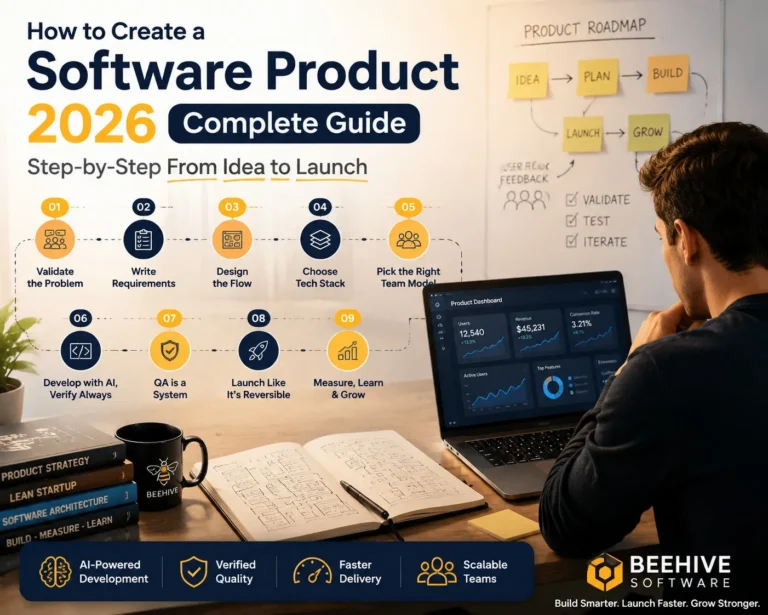
So if you’re asking how to build a software product in 2026, the honest answer is, the method changed. The bottleneck shifted from “Can we build it?” to “Should we build it, and can we trust what we built?” This guide takes you step-by-step through the whole experience from zero – validation, requirements, design, tech stack, team organization, development, QA, launch and growth, with that shift front and center.
At Beehive, we’re building custom software for startups and growth stage firms on a daily basis, so this is less theory and more field report on what actually works right now.
Step 1: Confirm the Problem Before Writing Code
The majority of software projects never make it past the planning stages, before a single line of code is written. For twenty years research has demonstrated that a big fraction of delivered features (the Standish Group’s famous CHAOS studies put it at around 80%) are rarely or never used. Nothing about AI has addressed that. If anything, cheap code generation enables you to produce the wrong thing faster.
The 2026 validation is about pressure-testing the idea against real behaviour, not declared interest. In practice:
“Have 10-15 discovery calls with people who are having the problem today. Ask what they do now and what they paid to have it fixed.
- Look at behavior, not opinions. Support tickets, workarounds in spreadsheets, and money already being spent are stronger signals than “yeah, I’d use that.”
- Decide what not to build. A one-page list of explicitly excluded features saves more money than any framework.
One thing AI genuinely helps with here: research synthesis. You can feed interview transcripts into an LLM and surface patterns in hours instead of weeks. Just don’t let it replace the interviews themselves.
Step 2: Write Requirements Like Money Depends on It (Because It Does)
Vague requirements are still where projects go to die. When we take over rescue projects at Beehive, the root cause is almost never bad engineering – it’s that nobody wrote down what “done” meant.
A working requirements spec in 2026 includes:
- Functional requirements – what the product does, expressed as user flows with acceptance criteria
- Non-functional requirements – latency targets, uptime expectations, device support
- Compliance constraints – if you’re anywhere near health data, payments, or EU users, HIPAA, PCI-DSS, and GDPR need to shape architecture from day one, not get bolted on later
Keep the spec live in Notion or Google Docs, linked to designs and the backlog, and update it weekly. A static PDF spec is dead on arrival.
There’s a new reason this matters more than ever: AI coding tools are only as good as the context you give them. A precise spec is now literally an input to your development speed, because ambiguous requirements produce confidently wrong AI output.
Step 3: Design the Flow Before the Interface
Good UX is architecture for human behavior. Start with journey maps and wireframes that prove the flow works, then worry about visual polish.
The 2026 twist is that prototyping got dramatically cheaper. Tools like Figma’s AI features and code-generation platforms let you put a clickable prototype in front of users within days. Use that speed for what it’s for: testing assumptions early, when changes cost nothing. Usability testing should start before the first real commit, not after launch.
One caution – AI-generated interfaces trend toward the generic. Your differentiation lives in the 20% of the experience that’s genuinely yours, so spend your design energy there.
Step 4: Choose a Tech Stack for Maintenance, Not for the Demo
Stack decisions in 2026 come down to three questions:
- Can you hire me for it? Python and TypeScript keep growing partly because AI tools handle them exceptionally well and the talent pool is deep.
- Does it fit the problem? A CRUD SaaS app doesn’t need Kubernetes on day one. An AI-heavy product needs data pipelines planned early.
- What will it cost to run? This one is new. If your product calls LLMs, inference costs scale with usage. Token economics – model choice, caching, prompt design – are now product decisions, not implementation details. We’ve seen products with great unit economics on paper get eaten alive by unplanned AI API spend.
Modular still wins architecturally. Decoupled components with defined boundaries allow for parallelising work, swapping out sections without rewriting, and keeping AI-generated code isolated and reviewable. That’s why Beehive’s whole concept is predicated on splitting projects into independent microtasks: small, well-bounded units are easier to design, test, and verify, whether a human or an AI touched them.
Step 5: Pick the Right Team Model
Your team structure sets your burn rate and your speed. The three options:
In-house. US developers average around $130,000 in base salary, plus 25-40% in benefits and overhead, plus recruiting costs and a 60-80 day time-to-hire. You get maximum context and control, at maximum cost and minimum flexibility.
Outsourced. Rates from $20-60/hour offshore versus $70-150+ domestic, with ramp-up in weeks instead of months. The risk is quality variance and communication overhead – which is why vetting and structured delivery matter more than the rate card.
Hybrid. Keep strategy and product ownership in-house, flex execution capacity externally. This is where most modern teams land. It’s also the model we built Beehive around – vetted senior engineers, paid per completed task rather than per hour, so capacity scales with your roadmap instead of your payroll.
Whichever model you choose, a lean pod of 5-7 people – engineers, a designer, a product owner, and embedded QA – outships bigger teams almost every time. Communication overhead grows faster than headcount.
Step 6: Development AI Speeds You Up, Verification Keeps You Alive
This is where 2026 looks genuinely different from even two years ago. Developers estimate that around 42% of committed code is now AI-assisted, and DX’s Q4 2025 analysis of 135,000+ developers found daily AI users merging about 60% more pull requests.
But here’s the counterweight: CodeRabbit’s December 2025 analysis found roughly 1.7x more issues in AI-coauthored pull requests, and 96% of developers express doubts about the reliability of AI-generated code. Some teams are even slower with AI – the METR randomized controlled trial found experienced developers took 19% longer with AI tools while believing they were 20% faster.
The lesson isn’t “avoid AI.” It’s that verification is the new bottleneck, and your process has to be designed for it:
- Every commit goes through peer review plus CI checks – no exceptions for AI-generated code, especially for AI-generated code
- Test coverage thresholds are enforced automatically, not aspirationally
- Small, reviewable pull requests beat big drops. A 2,000-line AI-generated PR is unreviewable in practice, which means it’s untrusted in practice
- Security scanning runs in the pipeline, because AI code introduces vulnerabilities at measurable rates
At Beehive, this is baked into how work flows: AI orchestrates and pre-checks, but every task passes automated test suites and human review before it reaches a client’s repo as a documented pull request. The client approves the merge. Speed without that verification layer is just deferred debugging.
Step 7: QA Is a System, Not a Phase
Testing after development is finished is how you turn cheap bugs into expensive ones – research has long suggested post-launch fixes cost 10-100x more than catching the same bug during development. Embed QA from day one:
- QA engineers involved at the spec stage, so requirements are testable
- Unit, integration, and regression suites running on every push
- Load testing and OWASP-based security audits before launch, not after the first incident
- A standing UAT environment where real users break things safely
The volume of code being produced went up. The only way quality keeps pace is if testing is continuous and largely automated.
Step 8: Launch Like It’s Reversible
Most launch disasters are preventable: skipped regression testing, shaky infrastructure, no rollback plan. Treat launch as a system:
- Final regression and load testing scoped by module
- Deployment through CI/CD with feature flags and instant rollback
- Monitoring live from second zero – error rates, latency, and funnel metrics on one dashboard
- Support docs and onboarding flows ready before users arrive, not after the first confused email
A soft launch to a limited segment beats a big-bang release almost every time. You want your worst bugs found by 50 forgiving early users, not 5,000 annoyed ones.
Step 9: The Product You Launch Is Half the Product You’ll Maintain
Maintenance typically consumes 40-60% of a software product’s lifetime cost, and teams that treat it as an afterthought pay that bill with interest. Plan from day one for:
- Weekly patch and performance cycles
- Automated uptime and security monitoring
- Embedded analytics, session replays, and in-app feedback driving the roadmap
- Regular interviews with power users – the people bending your product to do things you never intended are showing you the roadmap
Growth in 2026 is a feedback loop, not a phase. The teams that win instrument everything, ship small improvements weekly, and let real usage data settle roadmap arguments.
The Bottom Line
Knowing how to create a software product in 2026 demands the same fundamentals as always – validate before you build, spec before you code, test before you ship – plus one new discipline: treating AI as a powerful but unverified contributor whose work you systematically check.
Most teams still waste months building what a week of validation would have killed, or ship AI-accelerated code they can’t actually trust. You can skip both mistakes.
If you’re planning a build this year and want a team that has this process down to a system modular execution, embedded QA, verified AI-assisted delivery talk to Beehive. We’ll help you pressure-test the idea before anyone writes a ticket.