
MVP Development Services: The Complete Guide for USA Startups and Businesses
The launch of a new piece of software is a crap shoot. Many companies spend months building applications without knowing whether users truly need them. This results in higher expenses, late product launches and products that do not satisfy market expectations.
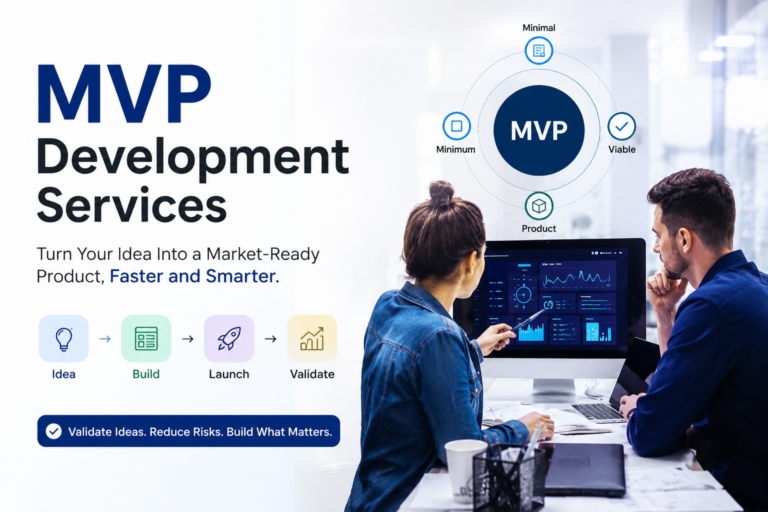
The risks can be reduced with the help of MVP development services. MVP development comprises building a Minimum Viable Product (MVP) that is a simplified version of a product with only the essential elements to address a particular problem. Companies can test their concepts, get real customer input and iterate the product depending on real market need rather than implementing every planned feature.
MVP development has become one of the most successful techniques to speed software development and reduce investment risks for startups and existing enterprises in the USA. This tutorial discusses in detail what you need to know about MVP development services, including benefits, development process, technologies, best practices, and typical mistakes.
What is MVP Development Services?
MVP development services is the process of planning, developing, testing and releasing a software product with the necessary functionality. The purpose is to test a business proposition before committing major resources to a full development.”
Instead of designing a full-featured program in the first place, developers focus on offering the basic functionality that solves the key problems of the user.
What’s a Minimum Viable Product?
A Minimum Viable Product (MVP) is the initial useable version of a software program that delivers enough value to early customers while enabling companies to collect relevant feedback.
- An MVP should:
- Solve one big problem
- Include just desired features
- Be kind to users
- Gather Customer Feedback
- Support for future enhancements
MVP Development Purpose
The main aim is to get insights from real users before building the whole product. “Companies can see which features customers value most, and avoid building things that aren’t needed.
Importance of MVP Development Services
Modern software development involves speed, flexibility and constant improvement. MVP development helps firms achieve these aims by validating concepts before scaling.
Rapid product validation
By releasing an MVP, organizations can get a sense of whether or not clients are interested in their service before investing considerably in its development.
Reduced Development Costs
Fewer features mean fewer development hours, therefore you’ll need less money to get started.
Lower business risk
Testing a product with real users mitigates the risk of building software no one wants.
Continual Product Improvement
Your feedback is crucial in shaping future growth and makes every update worthwhile.
Core advantages of MVP development services
Companies in many industries choose to establish an MVP because it delivers tangible benefits.
Benefit
- Why This Matters
- Time to market faster
- Get things to market faster and get feedback earlier
- Reduced Initial Investment
- Concentrate on core functionality to minimize development expenses
- Market Validation
- Validate consumer demand before scale-up.
- Improved Decision Making
- Leverage Real User Insights, Not Assumptions
- Product Growth Agility
- Develop functionalities as per customer requirements
- Increased Investor Confidence
- Show the product in use not an idea
What are the ingredients for a successful MVP?
Functionality should be limited to what is essential to meet the main goal of the MVP.
Core Product Functionality
The application should answer one well-defined consumer problem.
Register
Easy account creation and authentication enhance accessibility and security.
Design that responds
Applications are expected to work seamlessly on PCs, tablets, and smartphones.
Integration with Analytics
Tools for analytics are useful to track user interaction and find areas for development.
Customer Feedback System
Companies can gather useful user data using built-in feedback forms or surveys.
MVP creation process
A disciplined development approach raises the chances of a successful product launch.
Step 1 – Locate The Product
The first step is to set the target audience, market demand, and corporate goals.
Activities include: •
Market study
Competitor’s study
customer conversations
Verification of business
Step 2 – Prioritize the features
Not every feature you plan should be in your MVP.
Development teams prioritize features by:
Business value
User requirements
Development complication
Product goals
Step 3 – Design UX/UI
Developers don’t begin their work until designers build wireframes and interactive prototypes.
This helps validate the user path early on.
Step 4 – Software Development
The MVP is built with agile approaches and current development frameworks by developers.
The focus is still on quality, performance and scalability.
Step 5 – Test
Quality assurance teams check:
Benchmarking
Safety
Compatibility Functionality
User-experience
Testing helps to de-risk crucial issues before launch.
Step 6 – Go Live
MVP is released to early adopters to be tested in real-life situations.
Step 7 – Measure and Improve
Companies are watching how people use their product and constantly refining it based on feedback.
Commonly Used Technologies for MVP Development
Technology is chosen based on the project needs and future scalability.
Layer for Development
Popular Technology
Front End React, Vue.js, Angular Back End Node.js, Laravel, Django, ASP.NET
Mobile Flutter, React Native Database PostgreSQL, MySQL, Mongo DB Cloud
AWS, Microsoft Azure, Google Cloud Version control Git, GitHub, GitLab
Industries that Use MVP Development Services
MVP development is used by businesses in many industries to test new digital products.
Medical care
Healthcare firms are creating patient portals, appointment scheduling systems, and telemedicine solutions.
Financial Service
Fintech firms create payment systems, budgeting apps and digital banking platforms.
Online Retail
“Online businesses are launching shopping platforms with basic purchasing features and adding functionality from there.
Training
Educational institutions build online learning systems and virtual classroom apps.
Property
Property companies create listing portals, property management systems and customer dashboards.
Software as a Service (SaaS)
SaaS companies often start with an MVP to test out subscription-based products before adding more sophisticated features.
MVP versus Development of Full Product
- Knowing the difference helps organizations take the correct approach.
- Development MVP
- Full Product Development
- Basic features only.
- Full feature set
- Launch Faster
- Prolonged development schedule
- Lower upfront cost
- More investment
- Real world validation
- Assumptions about the market
- Continuous enhancements
- more pre-planning
- Less risk in a business
- Increased financial risk
MVP Development Best Practices
Product success is improved by established tactics.
Solve One Problem Well
“Add lots of features. Solve one customer problem.”
User Feedback at the Forefront
All future product updates should be driven by customer insights.
Design for Scalability
Even a minimal MVP should be extensible for the future.
Monitor performance metrics
The critical metrics are:
user buy
Active Members
Retention of customers
Conversion rate
Feature utilization
Customer’s contentment
Early discharge
Faster to market delivers crucial market information that you can’t get from assumptions.
Common Mistakes in MVP Development
Avoiding these blunders saves time and money on development.
Added too many features
Feature excess adds complication, not validation.
Overlooking customer feedback
Businesses should take customer feedback as a blueprint for future development.
Bad market research
Software built without a grasp of what the consumer requires is often a failure.
Postponing Launch
Waiting for a ‘perfect’ product hinders learning and increases costs.
How to Measure an MVPs Success
Successful MVPs are motivated by measurable results, not opinions.
- Success Indicator
- What It Measures
- User Signups
- Market demand.
- Customer Loyalty
- Value via time
- Users’ Participation
- Usefulness of product
- Quality of feedback
- Areas for Improvement
- Conversion Rate
- Corporate performance
- Revenue Growth
- Market validation
Future Trends of MVP Development
- The world of software development is changing.
- Trends to watch include:
- Artificial Intelligence Implementation
- No-code & low-code platforms
- Cloud Native Development
- API-first architecture
- Cross-platform application development
- Data driven product decisions
- Software Automated Testing
- Continuous delivery pipelines
- Companies that implement these techniques can speed innovation and remain flexible.
Frequently Asked Questions (FAQ)
What is MVP Development Service?
MVP development services mean building a minimal viable product with key features to validate a software idea before full-scale development.
Why do you need MVP?
An MVP helps minimize development costs, validate market demand, and helps firms improve their products based on client input.
MVP Development Timeline
Depending on the complexity of the project, the timeline varies. But many MVPs can be built in a few weeks to a few months.
MVP Development Services Who Needs?
Developing an MVP is advantageous for startups, entrepreneurs, companies, and corporations that are launching new software products.
Can the MVP morph into a full product?
Yes. Most successful software products start as MVPs and grow and expand through continuous updates based on client input.
Summary
MVP development services are the most practical way to produce successful software applications. You may test out concepts, minimize your financial exposure, get crucial client feedback, instead of burning all your cash building a whole app from the ground up.
MVP development gives businesses and organizations in the USA a chance to launch products faster, iterate and make educated business decisions. By listening to people, and focusing on the core features, organizations may create scalable digital solutions that match actual market needs.