
If you have spent any time around software teams, you’ve probably heard “QA” and “quality control” used interchangeably as if they’re the same thing. But they are not, and the difference isn’t just semantic. The difference between quality assurance and quality control actually shapes how teams plan work, catch bugs, and ship reliable software.
In this post, we’ll define quality assurance (QA) and quality control (QC), break down exactly where they diverge, and explain why the distinction matters if you’re building or scaling a software product.
What Is Quality Assurance?
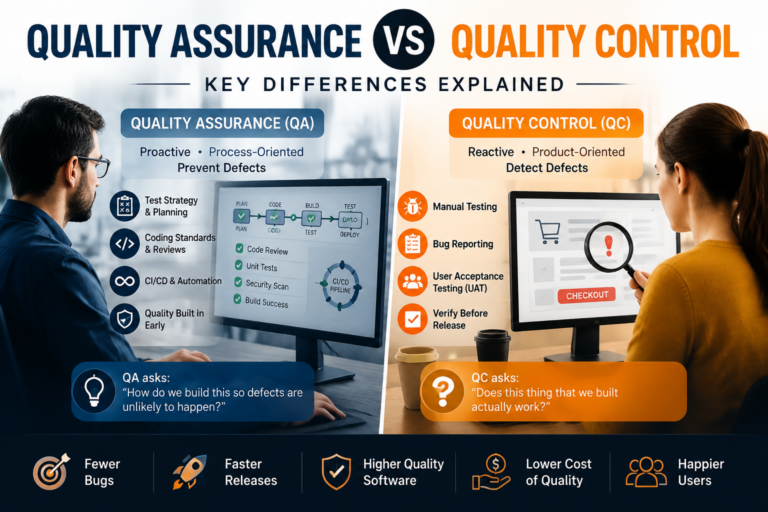
Quality assurance is process-oriented and proactive. It’s the discipline of preventing defects before they ever make it into a build, rather than catching them after the fact.
In software development, QA lives upstream. It’s the test strategy your team designs before a single line of code gets written. It’s the code review standards that catch risky patterns early. It’s the CI/CD pipeline configuration that runs automated checks on every commit. It’s sprint planning that builds testing time into the schedule instead of treating it as an afterthought.
QA asks, “How do we build this so defects are unlikely to happen in the first place?” It’s an engineering discipline, not a single task. Test plans, automation frameworks, coding standards, and release processes all fall under QA’s umbrella.
What Is Quality Control?
Quality control is product-oriented and reactive. It’s the set of activities focused on finding defects in something that’s already been built.
In software terms, QC is manual testing against a finished feature. It’s the bug report a tester files after finding a broken checkout flow. It’s user acceptance testing (UAT) before a release ships to production. QC happens downstream, after code exists, and its job is to verify that what was built actually works as intended.
QC asks, “Does this thing that we built actually work?” It’s the execution layer, the inspection step that either passes a release or sends it back.
QA vs QC – Side-by-Side Comparison
| Category | Quality Assurance | Quality Control |
|---|---|---|
| Focus | Process | Product |
| Goal | Prevent defects | Detect defects |
| When it happens | Before and during development | After development, before release |
| Who does it | Engineers, QA leads, process owners | Testers, QA analysts, end users (UAT) |
| Examples | Test strategy, code reviews, CI/CD setup | Manual testing, bug reporting, UAT |
| Orientation | Proactive | Reactive |
That table is the core distinction. Everything else in this post is really just an explanation of what happens when teams get it right, or get it wrong.
How QA and QC Work Together in Software Development
QA and QC aren’t competing approaches. They’re two halves of the same quality system, and the best software teams run them in tandem rather than picking one.
Put simply, QA shapes the process while QC validates the output.
Say you’re building a custom SaaS platform. QA shows up early setting up the testing frameworks, defining what “done” means for a feature, establishing coding standards, and building automated test coverage into the CI/CD pipeline. None of that touches a finished feature directly. It’s infrastructure.
QC shows up later, once there’s something to test. Before each release, QC runs through the test cases QA’s framework defines, checks the feature against acceptance criteria, and flags anything that doesn’t hold up. If QC finds a recurring class of bug, that feedback should loop back into QA – maybe the test strategy needs a new category of check, or the CI pipeline needs an additional gate.
Done well, this becomes a closed loop. QA reduces the number of defects that reach QC, QC catches what slips through, and the lessons from QC continuously sharpen QA. Skip either half, and the loop breaks.
Why the Distinction Matters for Your Project
Teams that treat “quality” as a single QC checkpoint at the end of a sprint or release cycle tend to run into the same problem. Bugs get caught late, when they’re expensive to fix.
This is where the cost of poor quality (CoPQ) becomes real. A defect caught during code review costs a few minutes of engineering time. The same defect caught in UAT costs a testing cycle and a delayed release. The same defect caught after it ships to production can cost customer trust, support tickets, emergency hotfixes, and in regulated industries, compliance exposure.
QC alone can tell you something is broken. It can’t tell you why your process keeps producing that kind of defect, and it can’t stop the next one from happening. That’s QA’s job. Teams that invest in QA processes – solid test strategy, automation, code review discipline – consistently ship fewer defects to QC in the first place, which means QC cycles get faster and releases get more predictable.
If your team is moving fast, especially with AI-assisted development accelerating how quickly code ships, skipping QA and relying on QC alone is a way of finding out about problems later and more expensively than you need to.
Getting QA and QC Right
The teams that ship reliable software consistently aren’t the ones with the most testers. They’re the ones who’ve built QA into how they work, so QC has less to catch by the time a release is ready.
If your team is struggling to balance QA process with QC execution, or you’re scaling fast enough that quality is starting to slip, we can help. Beehive works with software teams to build out testing frameworks, CI/CD quality gates, and QA processes designed for how fast modern development actually moves – including AI-assisted and vibe-coded builds where speed can outpace safety nets if QA isn’t built in from the start.
FAQ
Is QA the same as quality control?
QA is the proactive process built to prevent defects before they happen. QC is the reactive inspection process that finds defects in a finished product. They’re related but distinct functions within a quality system.
Which comes first, QA or QC?
QA comes first. It’s built into planning, coding standards, and test strategy from the start of a project. QC happens later, once there’s a feature or release ready to be checked against that strategy.
Can one person do both QA and QC?
Yes, especially on smaller teams. It’s common for a single QA engineer to both design test strategy (QA) and execute manual or automated tests against a build (QC). The distinction is about the type of work, not necessarily separate job titles.
What is quality assurance in software testing?
In software testing specifically, quality assurance refers to the frameworks, standards, and automated processes that guide how testing gets done – things like test plan design, coverage requirements, and CI/CD test automation – rather than the act of running a specific test.
Why is quality assurance important?
Because it’s cheaper and faster to prevent a defect than to find and fix one after the fact. Strong QA reduces the volume of bugs that reach later stages of development, which shortens release cycles and lowers the overall cost of quality.