
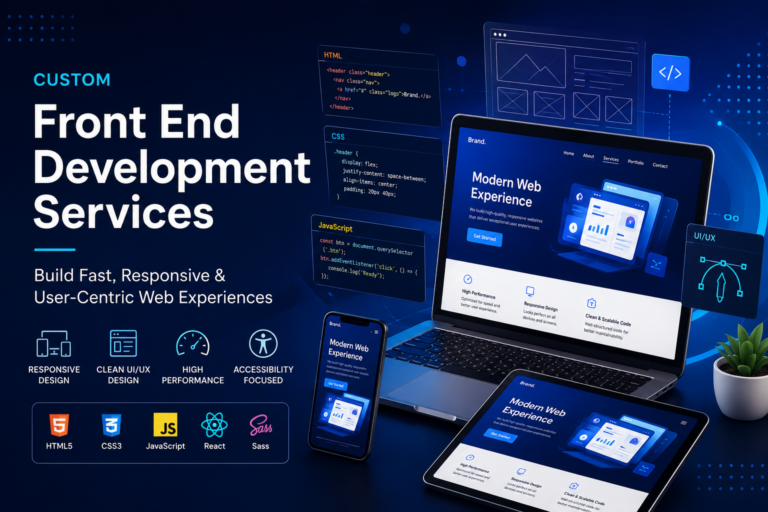
Modern users want websites to be fast, responsive, attractive, and easy to use. Cookie cutter templates and old school designs just don’t cut it anymore when it comes to providing a great digital experience for business. That’s why custom front end development services have become a crucial feature of modern website and web application development.
Custom front-end development involves the creation of one-of-a-kind user interfaces that communicate the company’s goals, branding, and consumer expectations. This is where developers design interactive experiences that improve usability, performance, and scalability over pre-built layouts.
Investing in a bespoke frontend can help businesses throughout the USA construct websites that not only look professional but run efficiently across all devices and browsers.
Understanding Custom Front End Development Solutions
The custom front end development services are all about designing and developing the elements of a website or web application that people see and interact with. The frontend is all you see: buttons, navigation menus, image galleries, dashboards, contact forms and animations.
Unlike template-based websites, custom development allows for every part of the interface to be developed specifically for your business requirements. This allows complete freedom in design, functioning and future improvements.
Modern front-end development is a creative and technological field. Developers work to guarantee visitors have a seamless browsing experience on any device.
The Basics of Front End Development
A custom frontend typically contains:
- Adaptive page layouts
- Navigation – interactive
- User friendly forms
- Mobile Friendly
- Blazing fast components
- Dynamic content
- Interactive dashboards
- User interfaces accessible
Each piece is meticulously designed to enhance use and client interaction.
Why Custom Front End Development Matters
A website is frequently the initial impression of a company. It is the first thing visitors decide on: to stay or to leave. And it is based on how easy it is to traverse the website and obtain information.
Custom front-end development enables firms to create experiences that fulfill user expectations and long-term business goals.
Enhanced User Experience
User experience plays a key part in customer happiness. A good interface design makes navigation straightforward and assists visitors to execute the activities in a more efficient way.
A good user experience will mean:
Longer visits to a website
Reduced bounce rates
More interaction
Better client satisfaction
Simplified navigation
If users can easily find what they want, then they will return.
Enhanced Website Performance
Performance is the major advantage of bespoke development.
Custom front-ends only have the features that a project really needs, rather than loading superfluous code seen in many templates.
This can be improved by:
Site Speed
Web Vitals
Mobile-friendly
General stability
Faster loading websites give a better experience to search engines and users alike.
Robust Brand Identity
Every firm has different branding needs.
Custom front-end development enables businesses to create uniform visual experiences through thoughtfully planned layouts, fonts, colors, icons, and animations.
A unique interface to build trust and enhance brand recognition for companies.
Technologies Used in Custom Front-End Development
Modern technologies are used by front-end developers to produce responsive and dynamic websites.
HTML
All web pages are built on top of HTML. It arranges headings , paragraphs , photos , buttons , forms and other site elements .
CSS
The appearance of the website is determined by CSS. It controls colors , fonts , layouts , spacing , animations , and responsive designs that adjust to various screen sizes .
Java Script
JavaScript adds features to webpages , making them interactive . Some of the capabilities that JavaScript adds are :
Form validation Dynamic menus
Live Updates
Sliders
Interactive graphs
Modern Front-End Frameworks Search feature
Lots of development teams also employ current frameworks for productivity and maintainability.
Some popular choices are:
Vue.js React Svelte Angular
These frameworks facilitate the construction of sophisticated web applications with great performance.
Top Advantages of Personalized Front End Development Services
Custom front-end solutions are chosen by businesses across a variety of industries because they offer flexibility and long-term value.
Responsive Design on All Devices
People are visiting websites on smartphones, tablets, laptops, desktops and even on enormous displays.
A responsive development provides a same experience to all the visitors regardless of the screen size.
More Accessibility
“Modern websites should be accessible to everybody, including people with disabilities.
Accessibility enhancements are:
- Keyboard navigation
- Screen reader friendly
- Proper heading structure
- high contrast colors
- Alternative text for pictures
- Focus indications are visible
Accessible websites are more usable for all visitors.
Cross Browser Compatibility
Different users use different browsers to browse the Internet.
Custom front-end development makes sure the websites function on
Google Chrome Microsoft Edge Mozilla Firefox Safari Opera
Consistent performance keeps users from getting frustrated.
More scalable
The needs of the business alter with time.
A bespoke frontend simplifies the addition of new features like:
Customer portals
Reservation systems
Payment processors
Dashboards for Analytics
Integration API
Interactive Tool
Scalable architecture enables growth without the need for a complete redesign.
Industries Benefiting from Custom Front End Development
Almost every sector benefits from user interfaces that are professionally designed.
Typical instances are:
Health Finance Education Manufucture Retail
Real Estate • Logistics • Government • Software as a Service (SaaS) • E-commerce
Custom development is a realistic alternative as different industries need distinct features.
Best Practices for Front-End Development
Modern development standards are the foundation of successful front-end projects.
- Some recommended methods are:
- design interfaces first on mobile
- Increase website loading speed
- Remove unneeded JavaScript
- Image compression
- Use semantic tags in HTML
- Follow accessibility guidelines.
- Test in multiple browsers
- Improve Core Web Vitals
- Create clear and reusable code
These principles produce stable, high-performing websites that give consistent experiences to users.
Future Trends in Frontend Development
Front-end technologies are constantly evolving as user expectations rise.
Emerging trends include:
Artificial intelligence integration
Progressive Web Applications (PWA)
Voice-based interfaces
Motion Graphic
UI systems based on components
Server-side rendering
Architecture of the Jamstack
Web Animations Advanced
Companies that embrace current front-end methods will see enhanced performance, greater user engagement and improved long-term scalability.”
Frequently Asked Questions
What are custom front end development services?
Custom front end development services involve designing and constructing customized user interfaces for websites and web apps, instead than using pre-built templates. These services focus on response, usability, performance and user experience.
Why pick custom front-end development for your company?
Custom development gives more flexibility, better performance, better branding, easier scalability and interfaces tailored to the business goals and consumer expectations.
Here are some of the most popular technologies used for front-end development:
Front-end developers usually employ HTML, CSS, JavaScript, React, Vue.js, Angular, Tailwind CSS, Bootstrap and other modern development technologies.
Does custom front end development assist with SEO?
“Yes. A good frontend leads to better site speed, mobile responsiveness, accessibility, user experience, and Core Web Vitals, all of which lead to better technical SEO.
Is responsive design part of custom front-end development?
Yes. Responsive design is one of the most crucial components of bespoke front-end development. It guarantees that websites run effectively on smartphones, tablets, laptops, and desktop computers.
What’s the difference between front-end and back-end development?
Front-end development is the visual interface that the user interacts with, and back-end development is the databases, servers, APIs, authentication and application logic that happens behind the scenes.
Summary
With custom front end development services, organizations are able to design quick, responsive, accessible, and visually appealing websites that are suited to their unique needs. Unlike generic templates, custom interfaces are designed with user experience, performance, branding and future scalability in mind.
Investing in a custom frontend lays a strong basis for digital growth and supports new web standards and changing client expectations for USA organizations. Good frontend design enhances usability and helps your website perform better and be more successful in the long run.