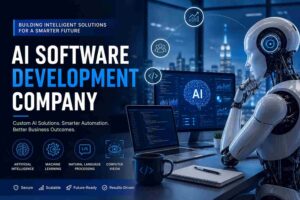


Artificial intelligence is changing how businesses operate across the United States. From automating repetitive tasks to improving customer experiences, AI has become an essential part of modern business strategy. Organizations of every size are exploring enterprise AI development to increase productivity, reduce operational costs, and make better decisions using data.
Unlike consumer AI applications, enterprise AI focuses on solving complex business challenges. It integrates with existing systems, supports large teams, protects sensitive information, and scales as organizations grow. Companies across industries such as healthcare, finance, retail, manufacturing, logistics, and education are investing in AI to stay competitive in an increasingly digital marketplace.
This guide explains what enterprise AI development is, how it works, its benefits, challenges, implementation process, and best practices for organizations in the USA.
What Is Enterprise AI Development?
Enterprise AI development is the process of designing, building, deploying, and maintaining artificial intelligence solutions specifically for business operations. These solutions help organizations automate workflows, analyze large volumes of data, improve decision-making, and deliver personalized customer experiences.
Unlike general AI tools, enterprise AI systems are customized to meet specific organizational requirements. They integrate with existing software, comply with industry regulations, and support long-term business growth.
Key Characteristics of Enterprise AI
Enterprise AI solutions typically include:
- Intelligent automation
- Machine learning models
- Natural language processing
- Computer vision
- Predictive analytics
- AI-powered decision support
- Workflow automation
- Data-driven insights
These technologies work together to improve efficiency while reducing manual effort.
Why Enterprise AI Development Matters
Businesses generate enormous amounts of data every day. Without AI, much of this information remains underutilized. Enterprise AI transforms raw business data into meaningful insights that support smarter decisions.
Common Business Goals
Organizations adopt enterprise AI to:
- Automate repetitive business processes
- Improve customer satisfaction
- Increase employee productivity
- Detect fraud and security risks
- Forecast demand accurately
- Optimize supply chains
- Reduce operational costs
- Support business growth
As AI technologies continue to evolve, companies that successfully adopt enterprise AI can respond faster to changing market conditions.
Core Technologies Used in Enterprise AI Development
Enterprise AI combines multiple technologies to solve business problems.
Machine Learning
Machine learning enables systems to learn from historical data and improve predictions without explicit programming.
Common applications include:
- Sales forecasting
- Customer segmentation
- Risk assessment
- Product recommendations
Natural Language Processing (NLP)
NLP allows computers to understand and process human language.
Typical business uses include:
- Customer support automation
- Document processing
- Email classification
- Sentiment analysis
Computer Vision
Computer vision enables AI systems to analyze images and videos.
Businesses use it for:
- Quality inspection
- Security monitoring
- Inventory tracking
- Medical imaging
Predictive Analytics
Predictive analytics identifies patterns that help organizations anticipate future outcomes.
Examples include:
- Demand forecasting
- Equipment maintenance
- Financial planning
- Customer behavior analysis
Enterprise AI Development Process
A structured development process improves project success and long-term scalability.
| Phase | Objective | Expected Outcome |
| Business Analysis | Identify goals and use cases | Clear AI strategy |
| Data Collection | Gather quality business data | Reliable datasets |
| Data Preparation | Clean and organize information | Accurate training data |
| Model Development | Train AI algorithms | Functional AI models |
| Testing | Validate performance | Reliable results |
| Deployment | Integrate into business systems | Operational AI solution |
| Monitoring | Track performance continuously | Ongoing optimization |
Following a systematic approach helps organizations reduce implementation risks.
Benefits of Enterprise AI Development
Enterprise AI offers measurable improvements across multiple business functions.
Improved Operational Efficiency
AI automates repetitive tasks, allowing employees to focus on higher-value work. This increases overall productivity and reduces human error.
Better Decision-Making
AI analyzes massive datasets in seconds and provides insights that support faster and more informed decisions.
Enhanced Customer Experience
Businesses can personalize interactions based on customer behavior, preferences, and purchasing history.
Increased Scalability
Enterprise AI systems can process growing amounts of data without significantly increasing operational costs.
Stronger Risk Management
AI helps identify unusual activities, detect fraud, monitor cybersecurity threats, and improve compliance efforts.
Industries Using Enterprise AI in the USA
Many industries are adopting enterprise AI to solve complex operational challenges.
Healthcare
Healthcare organizations use AI for:
- Medical image analysis
- Clinical decision support
- Appointment scheduling
- Patient record management
Financial Services
Financial institutions implement AI for:
- Fraud detection
- Credit risk analysis
- Customer support
- Investment analysis
Manufacturing
Manufacturers use AI to:
- Predict equipment failures
- Improve production planning
- Enhance quality control
- Reduce downtime
Retail
Retail businesses rely on AI for:
- Inventory management
- Demand forecasting
- Personalized recommendations
- Customer behavior analysis
Logistics
Logistics companies improve operations through:
- Route optimization
- Warehouse automation
- Shipment tracking
- Supply chain forecasting
Challenges in Enterprise AI Development
Although AI provides significant advantages, implementation requires careful planning.
Data Quality
Poor-quality data often leads to inaccurate AI predictions.
System Integration
Enterprise AI must integrate with existing software, databases, and business applications.
Security and Privacy
Organizations must protect sensitive business and customer information while complying with data privacy regulations.
Change Management
Successful AI adoption requires employee training and organizational support.
Continuous Improvement
AI models require ongoing monitoring, updates, and retraining to maintain accuracy over time.
Best Practices for Successful Enterprise AI Development
Organizations can improve AI project outcomes by following proven best practices.
Define Clear Business Objectives
Start with measurable business goals instead of focusing solely on technology.
Use High-Quality Data
Reliable data is the foundation of accurate AI models.
Start with High-Impact Use Cases
Begin with projects that provide measurable business value before expanding AI initiatives.
Ensure Strong Data Governance
Maintain data accuracy, security, compliance, and transparency throughout the project lifecycle.
Monitor AI Performance
Regular evaluation helps maintain model accuracy and supports continuous improvement.
Enterprise AI Development Trends
AI continues to evolve rapidly. Several emerging trends are shaping enterprise adoption.
Generative AI
Organizations increasingly use generative AI for content creation, document automation, software development, and knowledge management.
Explainable AI
Businesses are prioritizing transparent AI models that clearly explain how decisions are made.
AI Governance
Companies are implementing governance frameworks to ensure ethical AI usage, regulatory compliance, and responsible deployment.
Edge AI
Processing AI closer to devices reduces latency and supports faster decision-making for real-time applications.
AI-Powered Automation
Organizations continue expanding intelligent automation across finance, human resources, operations, and customer service.
How Businesses Should Prepare for Enterprise AI
Preparing for AI involves more than selecting technology. Organizations should evaluate their business goals, data readiness, infrastructure, security requirements, and employee skills.
A successful AI strategy combines strong leadership, quality data, scalable infrastructure, and continuous learning. Companies that invest in long-term planning are more likely to achieve sustainable business value from enterprise AI.
Frequently Asked Questions
What is enterprise AI development?
Enterprise AI development is the process of creating artificial intelligence solutions that help organizations automate workflows, analyze data, improve decision-making, and optimize business operations.
How is enterprise AI different from regular AI?
Enterprise AI is designed specifically for business environments. It integrates with enterprise software, supports scalability, enhances security, and addresses complex organizational challenges.
Which industries benefit most from enterprise AI?
Healthcare, finance, retail, manufacturing, logistics, education, insurance, telecommunications, and professional services all benefit from enterprise AI solutions.
What technologies are commonly used in enterprise AI?
Machine learning, natural language processing, computer vision, predictive analytics, deep learning, intelligent automation, and data analytics are among the most common technologies.
What are the biggest challenges in enterprise AI development?
The primary challenges include poor data quality, system integration, cybersecurity, regulatory compliance, employee adoption, and ongoing model maintenance.
Is enterprise AI suitable for small businesses?
Yes. Small and medium-sized businesses can implement enterprise AI by focusing on specific use cases such as customer service automation, sales forecasting, inventory management, or business analytics.
Summary
Enterprise AI development is transforming how businesses across the United States operate, compete, and innovate. By combining machine learning, natural language processing, predictive analytics, and intelligent automation, organizations can improve efficiency, enhance customer experiences, and make smarter business decisions.
Successful enterprise AI implementation requires clear objectives, reliable data, secure infrastructure, and continuous optimization. Businesses that approach AI strategically will be better positioned to adapt to future technological advancements while creating long-term competitive advantages.