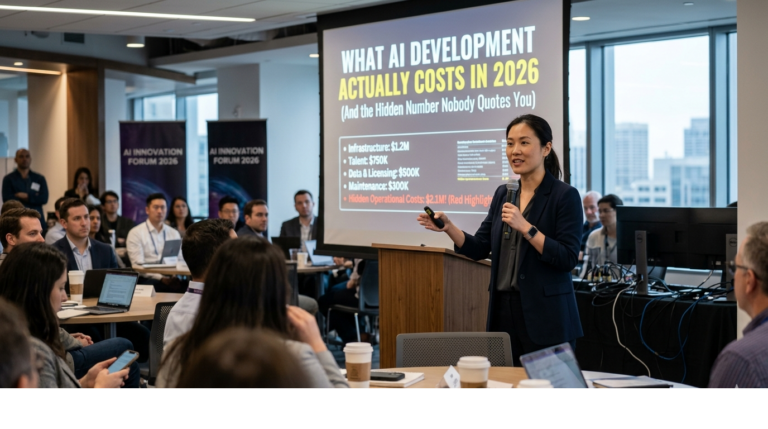
AI development cost varies dramatically based on project scope, technology requirements, and team composition. Whether you’re considering a simple chatbot or an enterprise-grade machine learning system, understanding the financial landscape helps you budget effectively and choose the right development approach. Beehive Software works with businesses to navigate these decisions, transforming AI ideas into production-ready solutions without the typical cost overruns or delays.
This guide breaks down the real numbers behind AI development, from initial investment to ongoing maintenance. You’ll discover what drives costs up or down, how different industries approach AI budgets, and which pricing models align with your goals.
TL;DR
AI project costs span a wide range depending on complexity. Simple solutions start around $5,000-$50,000, covering basic chatbots or automation tools. Medium complexity projects typically run $50,000-$150,000, while enterprise-grade AI systems reach $400,000 to $1,000,000+. The average monthly spend on AI infrastructure climbed to $85,521 in 2025, up 36% from $62,964 in 2024. Key cost drivers include compute infrastructure, specialized talent with AI engineers earning $100,000-$300,000 annually, and extensive data preparation. Geographic arbitrage can significantly reduce costs while maintaining quality.
Key Takeaways
- Project complexity directly determines your budget range
- Maintenance costs run 17-30% annually, potentially reaching 50% during regulatory changes
- Geographic location significantly impacts team rates
- Pre-built AI solutions offer faster deployment at lower upfront cost
- Infrastructure represents the dominant operational expense

Core Factors That Drive AI Development Costs
Five major factors shape your AI budget. Project complexity sets the baseline investment, while your chosen technology stack determines resource requirements. Data preparation often consumes more time and money than anticipated. Team composition varies dramatically by location and expertise level. Infrastructure decisions—cloud versus on-premises, GPU requirements, third-party licensing—round out the core cost drivers.
Project Complexity and Scope
Complexity acts as the primary budget determinant. A basic FAQ chatbot requires minimal custom work and standard APIs. Conversely, a real-time fraud detection system demands extensive data engineering, custom model architecture, and rigorous testing. Projects with rule-based systems deploy faster and cheaper than those requiring deep learning or continuous model refinement.
Simple AI Solutions ($5K-$50K)
Simple projects cost $5,000-$50,000 and take one to two months to deliver. These implementations rely on pre-trained models or basic APIs with minimal customization. Common examples include auto-fill systems, basic recommendation engines, and straightforward chatbots handling FAQs. Development teams can often reuse existing frameworks, reducing both time and expense.
Medium Complexity Projects ($50K-$150K)
Moderate AI projects range $50,000-$150,000, involving custom model training and deeper business process integration. Customer sentiment analysis, personalized recommendation systems, and risk management tools fall into this category. Development timelines extend from two to four months, requiring more sophisticated data pipelines and ongoing model monitoring.
Enterprise-Grade AI Systems ($400K-$1M+)
Complex enterprise projects start at $400,000 and can exceed $1 million. Large language model implementations, real-time AI for regulated industries, and predictive maintenance platforms require substantial data engineering, research, and infrastructure. Development cycles stretch six to twelve months or longer, with healthcare and financial systems demanding particularly high investments due to regulatory compliance and security requirements.
Type of AI Solution and Technology Stack
Technology choices directly impact both development costs and ongoing expenses. Machine learning models require less computational power than deep learning networks. Natural language processing implementations vary based on language support and context understanding depth. Computer vision systems demand specialized hardware and extensive training datasets.
Machine learning projects generally cost less than deep learning implementations. ML models train faster, require smaller datasets, and run efficiently on standard hardware. Deep learning demands powerful GPUs, massive training datasets, and specialized expertise, though it handles more complex patterns and unstructured data better than traditional ML approaches.
NLP costs span a wide range depending on functionality. Basic sentiment analysis or keyword extraction remains affordable, while context-aware systems understanding multiple languages and idioms require significant investment. Computer vision applications often require the highest upfront investment due to specialized hardware needs and extensive labeled training data. Quality image annotation services add substantial costs.
Generative AI and large language models represent some of the most expensive AI implementations due to training costs, compute requirements, and ongoing inference expenses. However, pre-trained model integration offers a cost-effective alternative, allowing businesses to leverage powerful AI capabilities without training from scratch.
Data Requirements and Preparation Costs
Data preparation often consumes 60-80% of AI project timelines. Raw data rarely arrives in usable format. Teams spend substantial time cleaning inconsistencies, handling missing values, and transforming formats. Quality directly impacts model performance, making shortcuts risky and expensive long-term.
Acquiring high-quality datasets can range from affordable to prohibitively expensive. Public datasets offer free options for common use cases, but proprietary or industry-specific data often requires licensing fees or partnerships. Data cleaning represents labor-intensive work requiring domain expertise to identify and correct errors, standardize formats, and remove duplicates.
Supervised learning requires labeled training data. Manual annotation costs vary by complexity: simple classification runs cheaper than detailed object detection or medical image annotation. Specialized annotation services charge by the label, with costs accumulating quickly for large datasets.
Privacy regulations add ongoing compliance expenses. HIPAA, GDPR, and industry-specific requirements mandate encryption, access controls, and audit trails. Financial services and healthcare face the strictest compliance requirements, driving up development and ongoing costs substantially.
Development Team Composition and Rates
Team expertise and location create dramatic cost variations. North American data scientists command premium salaries, while Eastern European or Latin American teams offer comparable skills at significantly lower rates. Team size, seniority mix, and project duration all factor into your total investment.
AI engineers and data scientists represent your largest personnel expense, with annual salaries ranging from $100,000 to $300,000 depending on experience and location. Senior professionals in San Francisco or New York command top-tier compensation, while offshore developers charge $60-$120 per hour versus $200-$350 for U.S.-based consultants.
ML engineers bridge the gap between data science and production deployment. They optimize models for performance, build training pipelines, and handle version control. DevOps specialists ensure reliable deployment, monitoring, and scaling. Together, these roles prevent common pitfalls where prototype models fail to perform in real-world conditions.
Outsourcing to Eastern Europe or Latin America can reduce development costs significantly compared to in-house North American teams. This geographic arbitrage maintains quality while substantially lowering burn rate. Beehive Software leverages a pre-vetted global talent network enhanced by AI technology, delivering cost-effective development without the quality-price trade-offs typical of conventional outsourcing.
Infrastructure and Technology Costs
Infrastructure represents a dominant portion of operational budgets. Cloud platforms offer flexibility and scalability, but expenses climb quickly with intensive compute needs. Hardware requirements vary dramatically between model types. Third-party services and licensing fees add recurring costs.
The average cost of computing is expected to climb 89% between 2023 and 2025, with 70% of executives citing generative AI as a critical driver. Every executive surveyed by IBM’s Institute for Business Value reported canceling or postponing at least one generative AI initiative due to cost concerns.
Cloud platforms operate on pay-as-you-go models, making initial experimentation affordable. However, training large models or running high-volume inference can cost thousands monthly. AWS SageMaker, Azure AI, and GCP AI offer managed services starting at $200-$400 per month, but enterprise deployments often exceed $10,000 monthly.
GPU costs depend on model complexity and training frequency. Cloud GPU instances range from $0.90 to $31 per hour depending on performance tier. Training a moderately complex model might require 100-500 GPU hours, translating to $90-$15,500 per training run. Continuous retraining or real-time inference multiplies these costs.
Pre-built APIs accelerate development but add recurring costs. OpenAI, Anthropic, and other providers charge per API call or token. Low-volume applications remain affordable, but high-traffic systems accumulate substantial monthly bills. Modern AI development also relies on tools for experiment tracking, model versioning, and performance monitoring, which offer free tiers for small teams but charge for enterprise features.

Development Approach: Cost Comparison Analysis
Choosing between in-house development, outsourcing, or hybrid models fundamentally shapes your budget and timeline. Custom solutions offer maximum control but require substantial investment. Pre-built alternatives deploy faster at lower upfront cost. Fixed-price versus time-and-materials contracts each carry distinct risk profiles.
In-House vs Outsourced AI Development
Building internal AI teams gives you complete control and deep institutional knowledge. However, in-house projects carrying significant costs can be reduced through outsourcing to skilled vendors. Internal teams align closely with business goals and build proprietary expertise, but recruitment costs, salaries, benefits, and ongoing training create substantial overhead. Companies must also invest in infrastructure, development tools, and management processes.
External partners provide immediate access to specialized expertise without recruitment overhead. Development firms bring proven methodologies, diverse project experience, and scalable resources. Choose partners with relevant industry experience and transparent communication practices to minimize risk.
Hybrid models combine internal strategic oversight with external execution capacity. Internal teams define requirements, manage vendor relationships, and maintain systems long-term while external partners handle intensive development phases, specialized tasks, or temporary capacity needs.
Custom AI Solutions vs Pre-Built Alternatives
Custom AI solutions require $100,000-$500,000+ upfront but offer complete control over algorithms, data handling, and intellectual property. Pre-built solutions deploy faster with monthly subscriptions as low as $200-$400, though many enterprises report concerns about vendor lock-in and limited customization. Projects take 9-18 months for custom builds versus 2-4 months for pre-built integration.
AIaaS platforms like AWS SageMaker, Azure AI, and Google Cloud AI offer ready-to-use AI capabilities through simple APIs. Businesses can implement sentiment analysis, image recognition, or forecasting without building models from scratch. Costs remain predictable through subscription models, though scaling can trigger higher usage fees.
Pre-trained models from OpenAI, Hugging Face, or industry-specific providers eliminate training costs and accelerate deployment. Fine-tuning these models for your specific use case requires less data and expertise than training from scratch. Custom development makes sense when your use case is unique, data is proprietary, or competitive advantage requires specialized algorithms.
Fixed-price contracts provide budget certainty and clear deliverables for well-defined projects with stable requirements. However, AI projects often involve discovery and iteration, making scope changes difficult under fixed pricing. Time-and-materials models offer flexibility for evolving requirements but require careful oversight to prevent cost overruns.
The Beehive Model: When It Works Best
Transparency note: Beehive Software offers this development approach. While we discuss our services, this guide aims to provide objective cost guidance applicable regardless of your chosen development partner.
Beehive Software utilizes a distinctive crowd-coding approach powered by AI technology. This model breaks projects into microtasks, instantly assigns them to expert engineers across a global 24/7 network, and delivers production-ready code without traditional bottlenecks. The system automates setup, code stitching, and quality assurance through embedded AI, eliminating context switching.
This approach works best for: Projects requiring rapid scaling of engineering capacity, initiatives with well-defined technical requirements, organizations seeking cost reduction without quality compromise, and businesses needing flexibility to scale resources up or down quickly.
This approach may not be ideal when: You require constant face-to-face collaboration with a dedicated team, your project involves highly specialized domain knowledge that requires deep institutional context, or you prefer traditional project management structures with fixed team assignments. In such cases, dedicated in-house teams or traditional consulting firms might better serve your needs.
Beehive scales engineering capacity in hours, supports all technologies, and ensures secure, zero-downtime deployments across fintech, healthcare, edtech, and other sectors.
Industry-Specific AI Development Costs
AI costs vary significantly across industries due to regulatory requirements, data complexity, and business model differences. Healthcare and financial services face the highest costs due to compliance and security needs. E-commerce and retail benefit from more standardized solutions at moderate prices. Manufacturing and logistics balance hardware integration with software development.
Healthcare AI Solutions
Healthcare leads AI investment with spending reaching $1.4 billion in 2025, up from less than $500 million in 2024. 22% of healthcare organizations have implemented domain-specific AI—a sevenfold increase over 2024. Adoption varies by segment: 27% at health systems, 18% at outpatient providers, and 14% at payers.
Nearly 77% of U.S. hospitals now use AI-powered ambient clinical documentation systems, significantly reducing physician burnout and administrative burden. AI can deliver cost reductions of 10-20% in hospital operating expenses, potentially saving the U.S. $300-$900 billion annually by 2050 according to Morgan Stanley analysis.
Acentra Health deployed MedScribe, an automated document-creation tool using Azure OpenAI, to address nursing time loss from manual documentation. The generative AI solution automated processing and approval of daily letters. Results: the system saved 11,000 nursing hours and nearly $800,000 in costs. Each nurse processed 20-30 letters daily with a 99% approval rate for MedScribe-generated documents, implemented within 2023-2025.
Beehive Software developed a medical technology web app leveraging AI to automate transcribing therapy sessions , reducing administrative workload substantially.
Financial Services and Fintech
In 2024, U.S. private AI investment grew to $109.1 billion—nearly 12 times China’s $9.3 billion and 24 times the U.K.’s $4.5 billion, according to Stanford HAI’s 2025 AI Index Report. Financial firms focus investments on fraud detection, KYC/AML compliance, and algorithmic trading.
Saxo Bank deployed GitHub Copilot across 700 developers to accelerate software development and reduce dependency on client services for routine queries. The integration automated code generation and deployed chatbots for client interaction. Measurable outcomes included approximately 30% faster coding rates, with developers using AI-written code in nearly all new applications. The implementation reduced time spent on routine coding tasks, freeing staff for complex problems, rolled out across 2024-2025.
One financial software company developed fraud detection in-house, detecting $8 million in fraud attempts within the first year—a 566% ROI that offset the $1.2 million development cost through avoided consultant fees and retained IP ownership.
E-commerce and Retail
Worldwide generative AI spending is forecasted to reach $644 billion in 2025, with retail representing a substantial portion targeting personalization, inventory optimization, and customer service automation.
Nykaa, India’s leading beauty and wellness retailer, integrated GitHub Copilot and Azure AI tools to automate repetitive development tasks and enhance productivity. The challenge was speeding up application development cycles while reducing manual coding costs. Using Copilot for code completion and Azure AI models for digital workflow automation, Nykaa achieved a 20% increase in developer productivity, accelerated feature release cycles with notable cost savings, and automated repetitive development tasks within the first year of implementation (late 2023-2024).
Manufacturing and Industrial AI
Toyota deployed a customized AI platform using Google Cloud’s AI infrastructure to democratize machine learning for factory workers. The challenge was creating agile, scalable ML/AI solutions within production environments that factory staff could use directly without data scientist involvement.
Leveraging Google Cloud’s managed AI infrastructure enabled workers to build and deploy low-code/no-code ML models focusing on defect prediction and operational optimization. The migration and implementation completed from 2024 to mid-2025 delivered rapid ML model deployment by non-technical staff and measurable improvements in process efficiency.
Manufacturing AI projects often balance software development with hardware integration, creating unique cost structures. Industrial solutions typically start at $120,000 per production line for full implementation, targeting predictive maintenance and process optimization.
Transportation and Logistics
Logistics providers invest heavily in route optimization, autonomous vehicles, and supply chain forecasting. Fleet management AI subscriptions range from $18,000-$90,000 annually depending on fleet size and features, with adoption accelerating across the sector.

Hidden Costs and Ongoing Expenses
Initial development represents only part of your total AI investment. Ongoing expenses for model retraining, infrastructure scaling, compliance, and support often surprise organizations. Annual maintenance typically runs 17-30% of original development cost, while compliance expenses can reach similar levels. Planning for these costs upfront prevents budget shortfalls that can derail AI initiatives.
Model Training and Retraining Costs
AI models degrade over time as real-world data shifts from training patterns. Retraining and fine-tuning typically costs 5-10% of initial development annually. For a $1 million AI investment, expect $50,000-$100,000 yearly for model updates. Research and engineering staff account for substantial portions of frontier model retraining budgets, covering technical debt remediation and architectural improvements needed for evolving workflows.
Infrastructure Scaling and Maintenance
As user volume grows, scaling cloud resources costs 5-15% of initial infrastructure investment per year. Companies like Netflix and YouTube report millions in annual scaling costs supporting recommender system improvements. Compute infrastructure represents a dominant portion of ongoing AI operational budgets, including cloud rental, GPU costs, and platform licensing fees.
Compliance and Regulatory Requirements
Regulatory changes constitute the most significant factor in maintenance cost fluctuations. Compliance costs can reach 17-30% of development budgets annually, potentially spiking to 50% during periods of rapid regulatory change. Requirements for governance, auditability, explainability, and security upgrades—such as those mandated by the EU AI Act—necessitate continuous investment in updated workflows and audit processes.
Cybersecurity demands constant vigilance through encryption, access controls, penetration testing, and security audits. Financial services and healthcare face the highest security expenses due to sensitive data handling and regulatory requirements. Budget for both preventive measures and incident response capabilities.
Performance Monitoring and Updates
Continuous monitoring ensures AI systems maintain accuracy and performance. Monitoring tools, alerting systems, and regular performance reviews require dedicated resources. Pre-built AI solutions typically cost $1,000-$10,000 annually for maintenance and support, while custom platforms require significantly higher ongoing investment.
Technical support covers bug fixes, feature updates, and user training. Internal support teams require full-time staff. External support contracts typically charge 15-20% of initial development cost annually. Regular updates keep systems compatible with evolving business needs and technology platforms, preventing technical debt accumulation.
When NOT to Build Custom AI
Before committing significant resources, honestly assess whether custom AI development aligns with your situation. Custom AI may not be appropriate when:
Insufficient data quality or quantity: AI models require substantial, clean, representative data. If your data is sparse, inconsistent, or poorly structured, focus on data infrastructure before pursuing custom AI development.
Unclear business problem: Without specific, measurable objectives, AI projects drift and fail to deliver ROI. Define exact problems and success metrics before development begins.
Available off-the-shelf solutions meet 80%+ of needs: If pre-built tools address most requirements, customization costs may outweigh marginal benefits. Start with existing solutions and customize only when clear gaps emerge.
Lack of organizational readiness: AI systems require ongoing maintenance, monitoring, and adaptation. Organizations without technical infrastructure, executive buy-in, or change management capabilities struggle to sustain AI investments.
Limited budget for ongoing costs: If you can only afford initial development without allocating 17-30% annually for maintenance and updates, AI systems will degrade and fail to deliver sustained value.
Consider these scenarios carefully. Sometimes waiting to develop AI capabilities, investing in foundational data infrastructure, or starting with simpler automation delivers better outcomes than premature custom AI development.
Frequently Asked Questions
What is the minimum budget needed for AI development?
Small businesses can begin experimenting with AI for $15-$100 per month using SaaS tools or cloud platforms, with many offering free tiers. Simple AI solutions cost $5,000-$50,000 for custom development. However, more impactful applications typically require at least $50,000 to achieve meaningful business results. Start with narrowly defined pilots targeting clear, measurable outcomes, then scale based on validated success metrics.
How long does AI development typically take?
Development timelines vary dramatically by project scope. Simple AI projects take one to two months, moderate complexity projects require two to four months, and enterprise systems need six to twelve months or longer. Building an AI MVP or integrating no-code/low-code tools often occurs within 2-8 weeks. Beehive Software’s crowd-coding approach often cuts development time substantially through modular workflows and 24/7 global engineering capacity.
What ongoing costs should I expect after deployment?
Annual maintenance typically runs 17-30% of original development cost, covering model retraining, infrastructure scaling, compliance, and technical support. Regulatory changes can spike costs to 50% during transition periods. For a $500,000 initial investment, plan for $100,000-$200,000 in annual ongoing costs to maintain performance and compliance.
How do I choose between building in-house vs outsourcing?
Evaluate your timeline, budget, and strategic importance of AI to your business. In-house development makes sense when AI represents a core differentiator, you have sustained needs justifying the investment, and you want complete IP ownership. Outsourcing works well for defined projects, when you need specialized expertise quickly, or when cost efficiency is paramount. Consider hybrid models that combine internal oversight with external execution for balanced control and cost management.
What are the most cost-effective AI solutions for small businesses?
Budget-friendly options include automation tools like Make.com, design platforms like Canva, customer support through Tidio, marketing content with Jasper or Copy.ai, and meeting analytics via Fireflies.ai—most ranging from free to $40-$100 monthly. Pre-built AI solutions and AIaaS platforms offer lower upfront costs and faster deployment than custom development. Focus on isolated pain points where AI delivers clear ROI, such as customer service automation, personalized recommendations, or data analysis.
How can I validate my AI idea before investing heavily?
Conduct a proof of concept targeting a specific, measurable outcome. Use prebuilt tools or modular platforms to limit technical risk. Set clear success metrics—time savings, cost reduction, revenue growth—and review outcomes after a defined test period of 30-90 days. Seek user feedback throughout to catch usability or accuracy issues early. Scale only when pilot KPIs show positive results. Beehive Software offers a free discovery consultation to assess project feasibility, provide timeline estimates, and define scope before committing to full development.
Conclusion
AI development cost depends on multiple factors: project complexity, technology stack, data requirements, team composition, and infrastructure needs. Simple solutions start $5,000-$50,000, moderate projects run $50,000-$150,000, while enterprise systems reach $400,000-$1,000,000+. The average monthly AI spend climbed to $85,521 in 2025, reflecting 36% growth from 2024 and increasing computational demands.
Geographic location, development approach, and pricing models create substantial cost variations. Healthcare leads investment with $1.4 billion in 2025 spending, while financial services benefit from strong ROI despite high initial costs. Computing costs are expected to climb 89% between 2023 and 2025, driven largely by generative AI demands.
Ongoing expenses add 17-30% annually, potentially reaching 50% during regulatory transitions. Small businesses benefit from pre-built solutions and AIaaS platforms offering lower upfront investment and faster deployment. Validating AI ideas through focused pilots with clear success metrics minimizes risk before scaling investments.
Beehive Software delivers cost-effective AI development through their crowd-coding approach, providing production-ready solutions without the overhead of in-house teams or quality trade-offs of conventional outsourcing. With proven success across healthcare, fintech, e-commerce, and manufacturing, Beehive Software transforms complex AI challenges into maintainable, high-impact systems backed by real-world results. Ready to explore AI development for your business? Schedule your free discovery call today to discuss your project goals, receive initial timeline and budget estimates, and discover how Beehive Software’s proven methodology can turn your AI vision into reality.