

Here’s an uncomfortable number to sit with before you spend a dollar on development: mobile apps lose roughly 77% of their daily active users within the first three days after install, and about 90% within the first month.
Most people read that and think it’s a marketing problem or an onboarding problem. It’s usually neither. In our experience building apps for healthcare companies, fintech startups, and consumer brands, the things you think about before developing a mobile app matter more than almost anything you do after. The apps that die in month one almost always make their fatal mistakes before a single line of code is written.
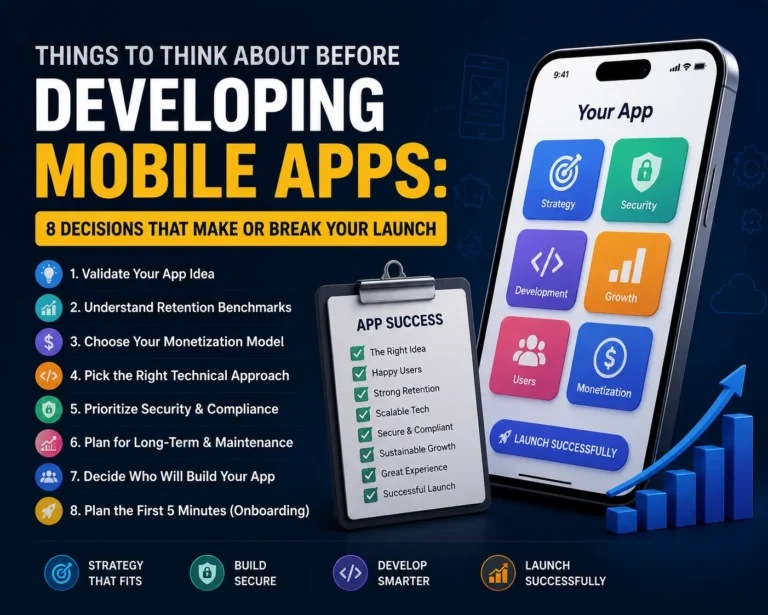
So instead of another checklist that tells you to “define your audience” and moves on, this post walks through the eight decisions that actually determine whether your app survives, with the numbers attached so you can see what each one costs when you get it wrong.
1. Be honest about whether the world needs your app
This sounds obvious, and yet it’s the mistake we see most often. Someone falls in love with an idea, and internal enthusiasm becomes the business case. As the product team at Future Mind puts it, internal enthusiasm is the cheapest signal you can buy and the most misleading.
Before development, you want evidence, not opinions. Two cheap ways to get it:
- Mine your competitors’ app store reviews. One-star reviews on competing apps are a free, brutally honest list of unmet user needs. If people keep complaining about the same missing feature, that’s your opening.
- Test intent before you build. A landing page that collects beta signups or pre-launch commitments tells you more in two weeks than a focus group tells you in two months.
If you can’t find evidence that people want this, that’s not a failure. That’s a few thousand dollars saving you a few hundred thousand.
2. Know your category’s retention math before you set goals
“We’ll worry about retention after launch” is how apps end up with growth charts that only go one direction. Retention benchmarks vary so much by category that they should shape what you build, not just how you measure it later.
The averages are sobering: around 25% of users return the day after installing an app, and by day 30 the average across categories sits near 5%. But the spread matters more than the average. By day 30, banking apps retain around 11.6% of users while shopping apps hold about 5.6%, roughly double, because checking your balance is a habit and buying a couch is not.
What this means practically: if you’re building an app people will only open occasionally, like an e-commerce or event app, designed for episodic use. Wishlists, saved states, and smart notifications matter more than daily engagement loops. If you’re building something habitual, the first week of the user experience is everything. Knowing which game you’re playing changes your feature priorities on day one.
3. Decide how the app makes money before you decide what it does
Monetization feels like a launch-phase question. It isn’t. Your revenue model quietly dictates your architecture.
A subscription app needs account management, payment infrastructure, and entitlement logic baked into its foundation. An ad-supported app needs SDK integrations and a data strategy that won’t get you rejected from app stores. Freemium needs a clean technical boundary between free and paid features, which is painful to retrofit.
Pick your model early, even if it’s a hypothesis. Changing your mind after launch is possible. Changing your mind after launch without expensive rework is rare.
4. Choose your technical approach with year two in mind
This is where most “things to consider” posts start, and it’s genuinely important, just not for the reason usually given. The native vs. cross-platform decision is less about performance and more about total cost of ownership.
Ballpark for 2025-2026: A full-featured native app will run you roughly $80,000-150,000 per platform, similar cross-platform projects are in the $50,000-100,000 range, and a basic hybrid app can start around $25,000. Estimates vary greatly by source and scope, with some studies putting the total range from $16,000 to more than $100,000, depending on features and number of platforms.
Some honest rules of thumb from projects we’ve shipped:
Go native when the product is performance and deep platform integration: gaming, camera-heavy apps, anything where a missed frame loses you people.
For most commercial, marketplace and content apps, go cross-platform (React Native or Flutter). So the performance gap has been decreased to the point that your users won’t notice, and you have one codebase instead of two.
If app store distribution is not a critical factor, look at PWA. Tens of millions of people use Airbnb’s progressive web app every month and PWAs may be updated immediately with no delays for store approval cycles.
The trap optimises only for launch cost. Two native codebases means two of every future bug fix, feature, and security patch. Whatever you choose, you’re picking it for years.
One additional thing that belongs in this decision because it’s a user experience choice disguised as a technical one: iOS and Android are not different platforms with different branding. Each has its own gestures, navigation patterns, and design principles, documented in Apple’s Human Interface Guidelines and Google’s Material Design. It feels subtly wrong to users to ignore them, and softly incorrect is enough to lose people who make up their minds about an app in minutes. Whatever path you pick, be prepared to adhere to the conventions of each platform, rather than providing a single, one-size-fits-all design to both.
5. Build security and compliance into the input, not a patch
If your app handles health data, payments, or any personal information, compliance is not a box to tick before submission. That’s an architectural choice.
HIPAA, SOC 2, GDPR, and PCI-DSS rules govern how you keep data, how you log access, what third-party SDKs you can use, and where your servers dwell. We all know that retrofitting compliance into a finished software frequently costs more than including it up front. The downside risk is worse than the cost, too: data breaches, lawsuits, and removal from app marketplaces.
A more quietly legal question you may want to answer early on is whether your software utilises any protected intellectual property. Finding out after launch that a key component is covered by someone else’s patent or copyright might derail a product altogether. Ten minutes with a lawyer before development beats ten months with one after development.
6. Budget for the app you’ll have in year two, not just at launch
An app is never done. Operating systems update, devices change, dependencies deprecate, and users expect a steady drip of improvements. The apps that feel abandoned get treated that way; users cite storage space and neglect among the top reasons they uninstall.
When you set your budget, set two numbers: what it costs to ship, and what it costs to keep alive each year after. A useful discipline is to write the second number down before signing anything, and to ask any development partner how they price ongoing work before you ask how they price the build. If the second number doesn’t exist in your plan, the first one is going to be wasted money. This is also where your development partner choice matters, because some engagement models let you scale maintenance up and down as needed, while others lock you into retainers whether you need the work or not.
7. Decide who’s actually developing your mobile app
This is the decision most posts dodge, so let’s be direct about the real options in 2026:
- In-house team. Maximum control and institutional knowledge, but slow to assemble and expensive to keep. Best when the app is the business.
- Freelancers. Cheap and fast for prototypes, risky for anything with compliance needs or a long life. Continuity is the problem.
- Traditional agencies. Reliable for well-scoped projects, but you inherit their process: sequential handoffs, weekly status meetings, and timelines measured in quarters.
- AI-orchestrated development. The newest model, and the one we obviously have a stake in at Beehive. AI breaks the project into small, independent tasks, routes each to a specialist engineer, and work happens in parallel instead of in sequence. The output arrives as tested pull requests to your own repo, so you review, merge, and deploy on your schedule, and you own the code outright.
There’s no universally right answer here. A technical founder with a clear spec has different needs than a healthcare executive with an idea and a compliance department. The right question isn’t “which option is best” but “which failure mode can I least afford”: slow speed, lost context, vendor lock-in, or lack of control.
8. Plan the first five minutes before you plan the first year
Here’s the pattern hiding in all the retention data: apps that nail first-session activation retain users at two to three times the rate of apps that don’t, regardless of category. The single most predictive metric for day-30 retention is whether users complete a meaningful first action on day one.
So before development starts, you should be able to answer: what is the one thing a new user must accomplish in their first session, and how many taps does it take? Every screen between install and that moment is where you’re losing 75% of your users.
Two more launch-phase items that belong in pre-development planning:
- App store optimization. Your name, keywords, screenshots, and description drive organic discovery, and over half of app installs come through store searches. Decide your positioning before you build, not after.
- A re-engagement plan. Users who receive even a single push notification in their first 90 days are three times more likely to stick around. That requires permission flows and messaging infrastructure designed in, not bolted on.
The bottom line is
None of these eight options requires developing code, and they will take you a few weeks of thinking together. Skipping them costs the typical app 90% of its users, and often its whole budget.
If you want a disciplined strategy to work through them, this is basically what a good discovery phase does pressure-testing the concept, mapping the architecture and putting real numbers on timeline and cost before committing to a build. It’s the stage we always recommend clients approach as non-negotiable at Beehive, whether they build with us or not, because the cheapest mistakes are the ones you make on paper.
The app market rewards teams that ship fast. But it rewards teams that thought first even more.