
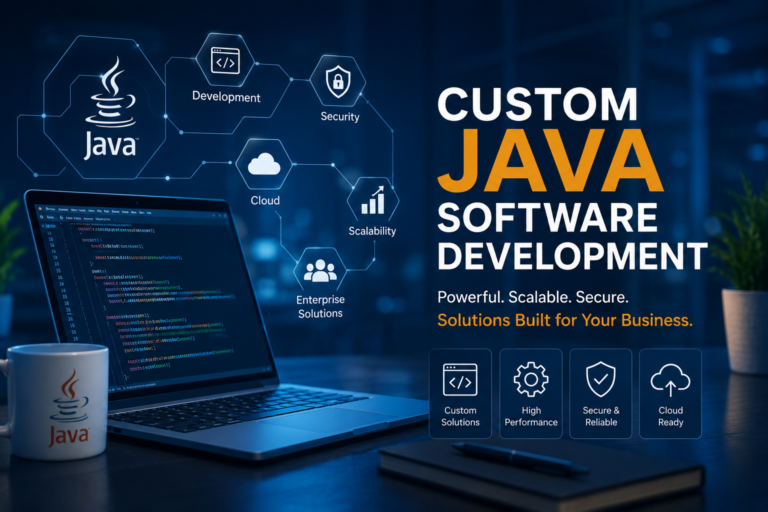
Now businesses require software that fits their goals, operations and future growth plans. You can buy off the shelf software that deals with common issues but it may include functionality that you don’t need or it may not have the flexibility that your organization requires. This is where custom software development in Java comes in.
For more than 20 years, Java has been one of the most trusted programming languages in the world. It powers enterprise applications, financial systems, healthcare applications, cloud services and big scale internet applications. The security, stability, scalability and cross-platform interoperability make Java a top choice for US enterprises.
In this course, you’ll be taken through custom Java software development, its benefits, development lifecycle, popular technologies, real-time scenarios and best practices to build strong business apps.
What is Custom Java Development?
Custom Java software development refers to the process of planning, building, testing and maintaining software applications that are specifically created for an organization’s needs using the Java programming language.
Unlike commercial software, custom solutions are built to solve a particular business problem, not for the broader public. We develop features, procedures and integrations that correspond with company goals without requiring teams to change their present way of working.
Java Custom Application Types include:
- Companies offer different kind of software solutions in Java like:
- Enterprise Resource Planning (ERP) systems.
- Customer relationship management software (CRM)
- Inventory management systems
- Applications to finance
- Healthcare platforms
- Business Software Cloud.
- Internal Business Tools API Services Web portal
Why Java Remains a Popular Choice.
Java has always gotten better, but it’s still very much in line with how we design software today.
Platform Independence
For Java applications, the idea of “Write Once, Run Anywhere” remains valid. Deploy programs to Windows, Linux and MacOS with minimal changes
Enterprise-Grade Security
Java has security measures to help protect programs against common vulnerabilities. Java is a very good programming language for sensitive information processing areas. Java supports secure authentication, safe encryption, and access management.
High performance
Modern JVM improvements enable programs to process huge workloads effectively and give predictable performance.
Scalability
Java programs can scale to serve more users, databases and business processes without costly re-building.
A Big Ecosystem of Development
Java includes lots of libraries, frameworks, development tools and community support to help you write applications and maintain them working over the long term.
Benefits of Custom Java Software Development
That’s why companies opt for custom software over boxed software, which is less flexible.
Business Process Tools
“Every organization is different. Custom software is designed to integrate with existing workflows, rather than forcing businesses to change how they work.
Improved System Integration.
Java Applications can integrate with: databases, payment gateways, ERP systems, CRM applications, cloud services, 3rd party APIs
• Improved data security
Businesses can put security controls in place as required by regulatory requirements and internal standards.
Cost effectiveness in the long term
Custom design can be more expensive initially but avoids the ongoing license payments and restrictions of off-the-shelf software.
Easier to grow in future.
As your business grows, you may add new modules, features and connectors.
Custom Software and Off-the-Shelf Software.
- Custom Application Java Features
- Software as a Service
- Business Ready
- Built for particular needs.
- Normal usage OK.
- MULTI-USE
- Limited, but very scalable.
- Great!
- Depends on vendor security.
- Specialized
- Consistent protection and integration
- Easy with existing systems.
- May need more tools.
- Proprietary
- Business management software
- Updates controlled by seller.
- Continued growth.
- Very versatile.
- Frequently restricted.
Custom Java Software Development Domains
Java is used in nearly every industry;
Health care (health insurance, health care
Healthcare staff utilize Java applications to manage patient information, schedule appointments, control hospital systems and communicate securely.
Banking & Finance
Banks and other financial organizations depend on Java for their payment processing, digital banking, investing platforms and fraud detection systems.
Making
Manufacturers write Java programs for activities such as inventory management, production planning, equipment monitoring, and supply chain.
Retail & eCommerce
Retailers use Java to power their e-commerce platforms, order management systems, warehousing software and consumer portals.
“Supply Chain
Transportation organizations utilize Java apps to manage shipments, operate warehouses, track vehicles and optimize delivery.
Education
Schools develop learning management systems, student portals, online assessment and administration software.
Customized Java Software Development Methodology
You need a disciplined development lifecycle to generate reliable software.
Analysis of Requirements 2. Developers collect business needs and define user requirements. They set project goals and describe technological specifications.
System Architecture & Planning
Architects do databases, software architecture, infrastructure, integrations, security, etc. before coding
User Interface & User Experience Design
Designers build interfaces that are intuitive, improve the user experience and generate efficient workflows.
Application Development
Developers can utilize Java technology to construct front-end interfaces, back-end services, APIs, business logic and database connectivity.
Quality Assurance Department
Testing covers functionality, performance, compatibility, Usability and security to make sure the application fulfills Business needs.
Implement:
If the program passes all the tests, it is released to the production environment and made available to the users.
Care and Maintenance
We maintain the program healthy throughout time with regular monitoring, security patches, bug fixes and feature additions.
Best Java Technologies Used
Today, the Java programming generally includes a combination of various free technologies.
Tech
Main purpose
Building Enterprise Applications with Spring Boot.
Spring Framework .
Application Architecture And Dependency injection
Sleep Database Administration Enterprise Java Apps using Jakarta EE.
Maven dependency management Gradle build automation.
Docker . Kubernetes Container Deployment
Application orchestration
REST APIs
Services Integration
MySQL/Postgress
Relational DB’s
Best Practices for Custom Java Software Development
The application of proven development approaches increases the quality of the software and reduces the maintenance costs in the long term.
clear maintainable code
Improving readability makes it easier to change later, and reduces technical debt.
Give Safety First.
Use secure authentication and role based access and use encryption Use vulnerability testing regularly.
Improved performance.
Reduce unnecessary DB calls, improve the RAM utilization and monitor the program performance.
Agile Development Follow
Incremental development enables teams to collect feedback and evolve with changing business needs.
Use automated testing
Automation helps enhance the quality of software by catching flaws early in the development lifecycle.
Design for scale; Applications should be designed to grow to serve future users, features and workloads without significant re-design.
java software development trends to watch out for technology continues to shape the way java apps are built
Artificial Intelligence Integration
More and more organizations are embedding AI-powered features into Java programs to automate and forecast results.
Cloud Native Applications
The cloud offers superior scalability, reliability and infrastructure management.
Microservice Architecture
Then large applications are divided into smaller independent services, which increases flexibility and maintainability.
DevOps Automation and
Continuous Integration (CI) and Continuous Deployment (CD) pipelines enable to deploy software faster and maintain quality.
5. API-First Development APIs are the connective tissue for business priorities, linking applications, cloud services and mobile platforms.
Frequently Asked Questions.
Is Java a good fit for enterprise applications?
Of course Java is used heavily in enterprise applications due to its great security, scalability and long term stability.
How long does it take to develop a custom java program?
Depending on the project size, complexity, features, and integration needs, development durations vary. Small applications could take weeks, big systems months.
Can Java integrate with existing corporate systems?
Yes, Java can be integrated with databases, cloud services, ERP platforms, CRM applications, APIs, payment gateways and third-party apps.
Is custom software more secure?
Custom apps enable enterprises to embed security that aligns with their own regulatory and operating standards.
Summary
Custom Java software development enables enterprises to design safe, scalable and flexible systems that are tailor-made to their specific operating needs. Rather of relying on off-the-shelf software, businesses have complete control over features, integrations, processes and future upgrades.
Java is one of the most reliable enterprise software technologies because it offers performance, security, platform independence and long term maintainability. Custom Java programming is a powerful base for digital transformation and long-term growth for business in the US, whether you are building cloud-based applications, internal corporate systems, financial platforms or customer-facing web solutions.