
Artificial intelligence is transforming how businesses operate across the United States. Companies are adopting intelligent technologies to automate processes, improve customer experiences, and make data-driven decisions. As organizations continue their digital transformation journey, enterprise AI development has become an essential strategy for improving efficiency and maintaining a competitive advantage.
Unlike consumer AI applications, enterprise AI focuses on solving complex organizational challenges. It integrates with business systems, analyzes large volumes of data, and supports decision-making across departments. This guide explains everything businesses need to know about enterprise AI development, including its benefits, applications, implementation process, challenges, and future trends.
What Is Enterprise AI Development?
Enterprise AI development refers to the design, development, deployment, and maintenance of artificial intelligence solutions specifically built for organizations. These solutions help automate business operations, improve productivity, and provide valuable insights through advanced data analysis.
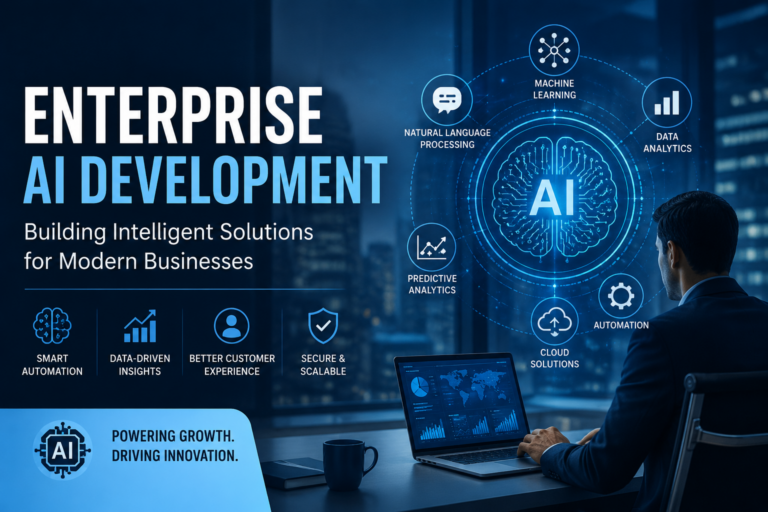
Enterprise AI combines multiple technologies to solve real business problems.
Machine Learning
Machine learning enables software systems to learn from historical data without being manually programmed for every task. Businesses use machine learning to predict outcomes, detect patterns, and improve operational efficiency.
Natural Language Processing (NLP)
Natural Language Processing allows computers to understand and process human language. Organizations use NLP in AI chatbots, virtual assistants, document analysis, and customer support automation.
Computer Vision
Computer vision enables AI systems to recognize images and videos. Industries such as manufacturing, healthcare, retail, and logistics use computer vision for inspections, quality control, and object detection.
Predictive Analytics
Predictive analytics helps businesses forecast future trends by analyzing historical and real-time data. This technology supports inventory management, financial planning, and demand forecasting.
Why Enterprise AI Development Is Important
Modern businesses generate enormous amounts of data every day. Without AI, much of this valuable information remains unused. Enterprise AI transforms raw data into meaningful business intelligence that helps organizations make faster and smarter decisions.
Some of the primary reasons companies invest in enterprise AI include:
- Improved productivity
- Better customer experiences
- Faster business decisions
- Lower operational costs
- Enhanced cybersecurity
- Increased business scalability
- More accurate forecasting
- Intelligent process automation
Benefits of Enterprise AI Development
Improved Operational Efficiency
AI automates repetitive and time-consuming tasks, allowing employees to focus on strategic work instead of manual processes.
Smarter Decision-Making
Enterprise AI analyzes massive datasets within seconds. Business leaders receive accurate insights that support faster and more informed decisions.
Cost Savings
Automation reduces labor-intensive tasks and minimizes operational expenses while improving overall efficiency.
Better Customer Experience
AI-powered systems deliver personalized recommendations, instant customer support, and faster response times.
Stronger Security
AI identifies suspicious activities, detects fraud, and helps organizations respond to cybersecurity threats before they become major issues.
Scalability
Enterprise AI solutions continue supporting organizations as they grow without requiring significant increases in manual effort.
Common Use Cases of Enterprise AI Development
Enterprise AI is transforming multiple industries across the United States.
| Industry | Enterprise AI Application | Primary Benefit |
| Healthcare | Medical imaging and diagnosis | Faster patient care |
| Finance | Fraud detection | Reduced financial risk |
| Manufacturing | Predictive maintenance | Lower downtime |
| Retail | Personalized recommendations | Better customer engagement |
| Logistics | Route optimization | Faster deliveries |
| Human Resources | Resume screening | Improved hiring efficiency |
| Customer Service | AI chatbots | 24/7 customer support |
How Enterprise AI Development Works
Successful enterprise AI projects follow a structured development process.
Define Business Objectives
Organizations first identify the business problems they want AI to solve.
Collect High-Quality Data
Accurate AI models require reliable and well-organized business data.
Prepare the Data
The collected information is cleaned, categorized, and prepared for machine learning.
Build AI Models
Data scientists train machine learning models using business-specific datasets.
Test the AI Solution
Before deployment, AI systems undergo extensive testing to ensure accuracy, fairness, and reliability.
Deploy Across the Organization
The AI solution integrates with existing enterprise software and business workflows.
Monitor and Improve
AI systems require continuous monitoring and updates to maintain optimal performance.
Best Practices for Enterprise AI Development
Organizations should follow proven strategies to maximize the success of AI projects.
- Define clear business goals.
- Focus on high-quality data.
- Start with small pilot projects.
- Ensure strong cybersecurity.
- Continuously monitor AI performance.
- Train employees to work with AI systems.
- Maintain compliance with data privacy regulations.
- Follow ethical AI principles.
- Measure performance using business KPIs.
- Regularly improve AI models.
Challenges of Enterprise AI Development
Although enterprise AI offers many advantages, organizations should prepare for common implementation challenges.
Poor Data Quality
Incomplete or inaccurate data reduces AI performance and prediction accuracy.
System Integration
Connecting AI with existing enterprise software can require additional planning and technical expertise.
Data Privacy
Organizations must protect sensitive business and customer information while complying with privacy regulations.
AI Skills Gap
Many businesses face challenges finding experienced AI developers, engineers, and data scientists.
Ethical Considerations
Responsible AI requires transparency, fairness, accountability, and continuous monitoring to reduce bias.
Future Trends in Enterprise AI Development
Enterprise AI continues to evolve as new technologies emerge.
Generative AI
Organizations increasingly use generative AI for content creation, software development, knowledge management, and employee productivity.
AI-Powered Business Intelligence
Modern analytics platforms combine AI with business intelligence to generate automated reports and predictive insights.
Responsible AI
Businesses are investing in explainable AI, governance frameworks, and ethical AI practices.
Edge AI
Processing AI closer to devices reduces latency and improves performance for real-time applications.
Cloud-Based AI
Cloud computing enables organizations to scale AI infrastructure quickly while reducing operational costs.
Frequently Asked Questions
What is enterprise AI development?
Enterprise AI development is the process of creating artificial intelligence solutions that automate business operations, improve decision-making, and analyze enterprise data.
Which industries use enterprise AI?
Healthcare, finance, manufacturing, retail, logistics, education, insurance, and telecommunications are among the industries that widely use enterprise AI.
Is enterprise AI suitable for medium-sized businesses?
Yes. Many medium-sized organizations use enterprise AI to improve efficiency, automate repetitive tasks, and support business growth.
What technologies are used in enterprise AI?
Common technologies include machine learning, deep learning, natural language processing, computer vision, predictive analytics, and cloud computing.
How long does enterprise AI implementation take?
Implementation timelines vary depending on project complexity, available data, and system integration requirements.
Is enterprise AI secure?
Enterprise AI can improve security when organizations implement proper cybersecurity measures, access controls, and data governance.
Summary
Enterprise AI development has become a key driver of digital transformation for organizations across the United States. Businesses use AI to automate operations, improve productivity, strengthen security, and make data-driven decisions with greater confidence. As AI technologies continue to evolve, organizations that invest in responsible, scalable, and well-planned enterprise AI strategies will be better positioned to innovate, compete, and achieve long-term growth.