Web Development, AI Development, Custom Software Development, IT Strategy Consulting, Software Architecture, Data Engineering & Research, and QA services work together to support advanced Trauma Intervention Data Mapping solutions. By combining intelligent data processing, scalable software architecture, AI-driven analytics, and rigorous quality assurance, organizations can improve data accuracy, streamline intervention workflows, and gain actionable insights for more effective trauma response and decision-making.
Django, React, Next.js
Amazon Web Service, Kubernetes
Python, TypeScript
MariaDB
AEDP, a widely recognized psychotherapy model, has helped thousands of clinicians worldwide heal trauma and alleviate emotional suffering. To evaluate treatment effectiveness, therapists audiovisually record sessions and manually document findings, interventions, and outcomes. However, managing and analyzing this information can be time-consuming. Through Trauma Intervention Data Mapping, clinicians can organize therapeutic data more efficiently, identify treatment patterns, track patient progress, and gain deeper insights into the impact of specific interventions.
Diana Fosha, founder of AEDP, approached Beehive with a groundbreaking vision: to develop an innovative Trauma Intervention Data Mapping platform capable of standardizing and analyzing psychotherapy sessions at an unprecedented level of detail. The goal was to explore the relationship between moment-to-moment shifts in a patient’s emotional state and specific therapist interventions, enabling researchers and clinicians to identify meaningful patterns, measure treatment effectiveness, and advance trauma-informed care through data-driven insights.
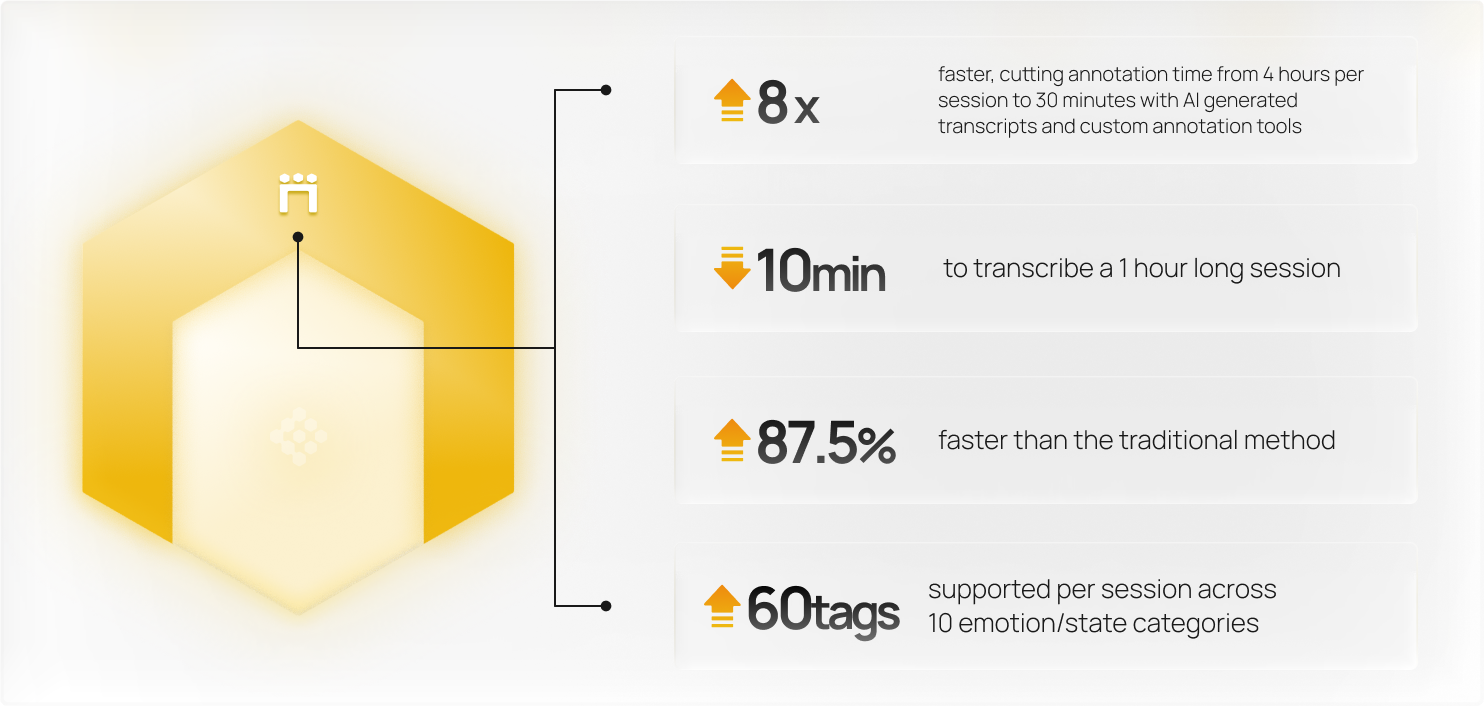
Following an extensive discovery and research phase, the Beehive team presented Diana with a comprehensive roadmap for Trauma Intervention Data Mapping, covering data collection, platform design, user experience, and product development. The solution was built with full HIPAA compliance and introduced automated annotation workflows that significantly reduced the time therapists spent documenting treatments. A centralized dashboard standardized data collection and enabled detailed analysis of patient emotional states alongside therapist interventions. This foundation supports advanced Trauma Intervention Data Mapping by uncovering effective therapeutic techniques and creating measurable treatment insights. The long-term vision includes leveraging AI-driven analytics to evaluate session effectiveness through quantified metrics such as conversation patterns, vocal tone, emotional responses, and facial expressions, providing clinicians with deeper, data-backed understanding of therapeutic outcomes.
The platform automatically transcribes therapy sessions and enables clinicians to annotate emotional states using standardized, research-based metrics. As a core component of the Trauma Intervention Data Mapping framework, this functionality transforms unstructured session recordings into structured, searchable data, making it easier to track patient progress, correlate emotional shifts with therapist interventions, and generate meaningful insights into treatment effectiveness.
Therapists are expected to use the product to upload sessions.
Therapists use the product to upload sessions
As the dataset continues to expand, the next phase of the Trauma Intervention Data Mapping platform will focus on identifying relationships between therapist interventions, patient emotional experiences, and treatment outcomes. By analyzing these connections at scale, the system will generate measurable evidence of intervention effectiveness, uncover clinically valuable patterns, and support more personalized, data-driven treatment approaches. This evolution will help clinicians make informed decisions, improve therapeutic outcomes, and enable scalable delivery of effective trauma care.
Bridging the worlds of data science and psychotherapy to better understand emotional suffering is no small challenge. Yet Yaron and his team demonstrated exceptional listening, communication, and technical expertise throughout the project. Their ability to translate the nuances of our clinical work into automated Trauma Intervention Data Mapping protocols has opened the door to entirely new ways of exploring and understanding our data capabilities that once seemed unimaginable but are now becoming a reality.
AEDP Founder